Which metal cation is the best oxidizing agent? a. Pb2+ b. Cr3+ c. Fe2+ d. Sn2+
Ch.19 - Electrochemistry
Tro4th EditionChemistry: A Molecular ApproachISBN: 9780134112831Non è quello che usi tu?Cambia libro di testo
Capitolo 19, Problema 62c
Calculate E°cell for each balanced redox reaction and determine if the reaction is spontaneous as written. c. PbO2(s) + 4 H+(aq) + Sn(s) → Pb2+(aq) + 2 H2O(l) + Sn2+(aq)
Guida verificata passo dopo passo1
Identify the half-reactions involved in the redox process. For the given reaction, the half-reactions are: PbO_2(s) + 4H^+(aq) + 2e^- \(\rightarrow\) Pb^{2+}(aq) + 2H_2O(l) and Sn(s) \(\rightarrow\) Sn^{2+}(aq) + 2e^-.
Look up the standard reduction potentials (E°) for each half-reaction from a standard reduction potential table. The standard reduction potential for PbO_2 to Pb^{2+} is typically positive, while for Sn to Sn^{2+} it is negative.
Calculate the standard cell potential (E°_{cell}) by using the formula: E°_{cell} = E°_{cathode} - E°_{anode}. Identify which half-reaction is the reduction (cathode) and which is the oxidation (anode).
Determine the spontaneity of the reaction. If E°_{cell} is positive, the reaction is spontaneous as written. If it is negative, the reaction is non-spontaneous.
Summarize the findings: State the calculated E°_{cell} and whether the reaction is spontaneous or not based on the sign of E°_{cell}.

Risposta video verificata per un problema simile:
Questa soluzione video è stata consigliata dai nostri tutor come utile per risolvere questo problema.
Durata del video:
5mConcetti chiave
Ecco i concetti essenziali che devi comprendere per rispondere correttamente alla domanda.
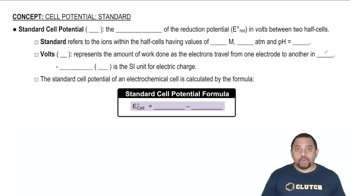
Standard Electrode Potential (Ec°ell)
The standard electrode potential, Ec°ell, is a measure of the tendency of a chemical species to be reduced, expressed in volts. It is determined under standard conditions (1 M concentration, 1 atm pressure, and 25°C). A positive Ec°ell indicates a spontaneous reaction, while a negative value suggests non-spontaneity. Calculating Ec°ell involves using the standard reduction potentials of the half-reactions involved in the redox process.
Video consigliato:
Percorso guidato
Standard Cell Potential
Redox Reactions
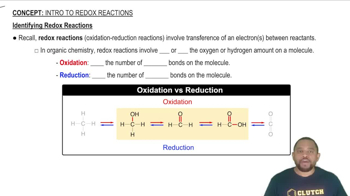
Redox reactions involve the transfer of electrons between two species, where one is oxidized (loses electrons) and the other is reduced (gains electrons). In the given reaction, lead dioxide (PbO2) is reduced to lead ions (Pb2+), while tin (Sn) is oxidized to tin ions (Sn2+). Understanding the oxidation states and identifying the oxidizing and reducing agents are crucial for balancing the reaction and calculating Ec°ell.
Video consigliato:
Percorso guidato
Identifying Redox Reactions
Spontaneity of Reactions
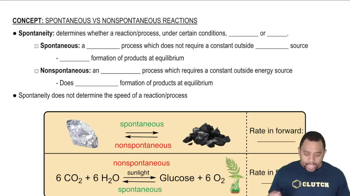
The spontaneity of a reaction refers to its ability to occur without external intervention. In electrochemistry, a reaction is spontaneous if the calculated standard cell potential (Ec°ell) is positive. This indicates that the free energy change (ΔG) for the reaction is negative, favoring the formation of products. Evaluating the spontaneity helps predict whether the reaction will proceed as written under standard conditions.
Video consigliato:
Percorso guidato
Spontaneity of Processes
Pratica correlata
Domanda del libro di testo
1359
views
Domanda del libro di testo
Calculate E°cell for each balanced redox reaction and determine if the reaction is spontaneous as written. a. O2(g) + 2 H2O(l) + 4 Ag(s) → 4 OH–(aq) + 4 Ag+(aq) b. Br2(l) + 2 I–(aq) → 2 Br–(aq) + I2(s)
864
views
Domanda del libro di testo
Calculate E°cell for each balanced redox reaction and determine if the reaction is spontaneous as written. b. MnO2(aq) + 4 H+(aq) + Zn(s) → Mn2+(aq) + 2H2O(l) + Zn2+(aq) c. Cl2(g) + 2 F–(aq) → F2(g) + 2 Cl–(aq)
444
views
Domanda del libro di testo
Calculate E°cell for each balanced redox reaction and determine if the reaction is spontaneous as written. a. 2 Cu(s) + Mn2+(aq) → 2 Cu+(aq) + Mn(s)
1221
views
Domanda del libro di testo
Use tabulated electrode potentials to calculate ∆G°rxn for each reaction at 25 °C. b. Br2(l) + 2 Cl–(aq) → 2 Br–(aq) + Cl2(g) c. MnO2(s) + 4 H+(aq) + Cu(s) → Mn2+(aq) + 2 H2O(l) + Cu2+(aq)
845
views