Ch.19 - Electrochemistry
Tro - Chemistry: A Molecular Approach 4th Edition
Tro4th EditionChemistry: A Molecular ApproachISBN: 9780134112831Non è quello che usi tu?Cambia libro di testo
Capitolo 19, Problema 44b,c

Sketch a voltaic cell for each redox reaction. Label the anode and cathode and indicate the half-reaction that occurs at each electrode and the species present in each solution. Also indicate the direction of electron flow.
b. 2 H+(aq) + Fe(s) → H2(g) + Fe2+(aq)
c. 2 NO3–(aq) + 8 H+(aq) + 3 Cu(s) → 2 NO(g) + 4 H2O(l) + 3 Cu2+(aq)

Guida verificata passo dopo passo
1
Step 1: Identify the oxidation and reduction half-reactions for each redox reaction. For reaction b, Fe(s) is oxidized to Fe^{2+}(aq), and H^{+}(aq) is reduced to H_{2}(g). For reaction c, Cu(s) is oxidized to Cu^{2+}(aq), and NO_{3}^{-}(aq) is reduced to NO(g).
Step 2: Determine the anode and cathode for each reaction. The anode is where oxidation occurs, and the cathode is where reduction occurs. For reaction b, Fe(s) is the anode, and H^{+}(aq) is the cathode. For reaction c, Cu(s) is the anode, and NO_{3}^{-}(aq) is the cathode.
Step 3: Write the half-reactions for each electrode. For reaction b, the anode half-reaction is Fe(s) → Fe^{2+}(aq) + 2e^{-}, and the cathode half-reaction is 2H^{+}(aq) + 2e^{-} → H_{2}(g). For reaction c, the anode half-reaction is Cu(s) → Cu^{2+}(aq) + 2e^{-}, and the cathode half-reaction is 2NO_{3}^{-}(aq) + 8H^{+}(aq) + 6e^{-} → 2NO(g) + 4H_{2}O(l).
Step 4: Label the species present in each solution. For reaction b, the anode solution contains Fe^{2+}(aq), and the cathode solution contains H^{+}(aq). For reaction c, the anode solution contains Cu^{2+}(aq), and the cathode solution contains NO_{3}^{-}(aq) and H^{+}(aq).
Step 5: Indicate the direction of electron flow. Electrons flow from the anode to the cathode in both reactions. For reaction b, electrons flow from Fe(s) to H^{+}(aq). For reaction c, electrons flow from Cu(s) to NO_{3}^{-}(aq).

Risposta video verificata per un problema simile:

Questa soluzione video è stata consigliata dai nostri tutor come utile per risolvere questo problema.
Durata del video:
2m

Concetti chiave

Ecco i concetti essenziali che devi comprendere per rispondere correttamente alla domanda.

Voltaic Cell Structure

A voltaic cell, also known as a galvanic cell, consists of two electrodes: the anode and the cathode, immersed in electrolyte solutions. The anode is where oxidation occurs, releasing electrons, while the cathode is where reduction takes place, accepting electrons. The flow of electrons from the anode to the cathode generates electrical energy, which can be harnessed for work.
Video consigliato:
Percorso guidato
01:21
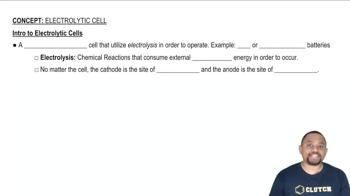
The Electrolytic Cell

Redox Reactions

Redox reactions involve the transfer of electrons between two species, where one species is oxidized (loses electrons) and the other is reduced (gains electrons). In the provided reactions, identifying the oxidation states of the elements helps determine which species undergoes oxidation and which undergoes reduction. Understanding these processes is crucial for sketching the voltaic cell accurately.
Video consigliato:
Percorso guidato
03:12
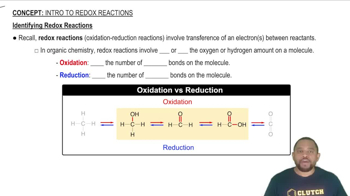
Identifying Redox Reactions

Half-Reactions

Half-reactions represent the individual oxidation and reduction processes occurring in a redox reaction. Each half-reaction shows the species involved, the electrons transferred, and the changes in oxidation states. By writing the half-reactions for the given reactions, one can clearly label the anode and cathode in the voltaic cell and understand the overall electron flow and species present in each half-cell.
Video consigliato:
Percorso guidato
07:19
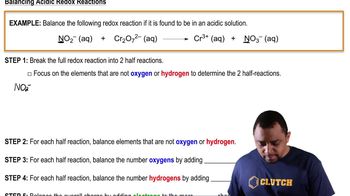
Redox Half Reactions Example