Ch.19 - Electrochemistry
Tro - Chemistry: A Molecular Approach 4th Edition
Tro4th EditionChemistry: A Molecular ApproachISBN: 9780134112831Non è quello che usi tu?Cambia libro di testo
Capitolo 19, Problema 111

The cell potential of this electrochemical cell depends on the pH of the solution in the anode half-cell. Pt(s) | H2(g, 1 atm) | H+(aq, ? M) || Cu2+(aq, 1.0 M) | Cu(s) What is the pH of the solution if Ecell is 355 mV?

Guida verificata passo dopo passo
1
Identify the half-reactions for the electrochemical cell. The anode half-reaction involves hydrogen: \( \text{H}_2(g) \rightarrow 2\text{H}^+(aq) + 2e^- \). The cathode half-reaction involves copper: \( \text{Cu}^{2+}(aq) + 2e^- \rightarrow \text{Cu}(s) \).
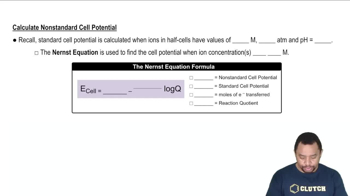
Write the Nernst equation for the cell potential: \( E_{cell} = E^\circ_{cell} - \frac{RT}{nF} \ln Q \), where \( Q \) is the reaction quotient.
Calculate the standard cell potential \( E^\circ_{cell} \) using standard reduction potentials: \( E^\circ_{cell} = E^\circ_{cathode} - E^\circ_{anode} \). Use standard reduction potentials for \( \text{Cu}^{2+}/\text{Cu} \) and \( \text{H}^+/\text{H}_2 \).
Express the reaction quotient \( Q \) in terms of concentrations: \( Q = \frac{[\text{H}^+]^2}{[\text{Cu}^{2+}]} \). Given \([\text{Cu}^{2+}] = 1.0 \text{ M}\), simplify \( Q \) to \( [\text{H}^+]^2 \).
Rearrange the Nernst equation to solve for \([\text{H}^+]\), and then calculate the pH using \( \text{pH} = -\log[\text{H}^+] \).

Risposta video verificata per un problema simile:

Questa soluzione video è stata consigliata dai nostri tutor come utile per risolvere questo problema.

Concetti chiave

Ecco i concetti essenziali che devi comprendere per rispondere correttamente alla domanda.

Nernst Equation

The Nernst Equation relates the cell potential (E) of an electrochemical cell to the concentrations of the reactants and products. It is expressed as E = E° - (RT/nF)ln(Q), where E° is the standard cell potential, R is the gas constant, T is the temperature in Kelvin, n is the number of moles of electrons transferred, F is Faraday's constant, and Q is the reaction quotient. This equation allows us to calculate the effect of concentration changes on the cell potential.
Video consigliato:
Percorso guidato
01:17
The Nernst Equation

pH and Hydrogen Ion Concentration

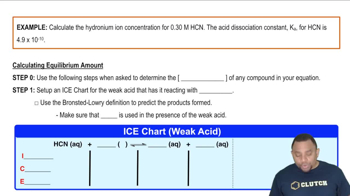
pH is a measure of the acidity or basicity of a solution, defined as the negative logarithm of the hydrogen ion concentration: pH = -log[H+]. In electrochemical cells, the pH can influence the concentration of H+ ions, which in turn affects the cell potential. A lower pH indicates a higher concentration of H+ ions, which is crucial for determining the conditions in the anode half-cell.
Video consigliato:
Percorso guidato
06:25
Hydronium Ion Concentration Example

Electrochemical Cell Components

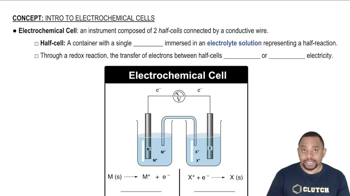
An electrochemical cell consists of two half-cells: the anode, where oxidation occurs, and the cathode, where reduction takes place. In the given cell, the anode involves hydrogen gas and protons, while the cathode involves copper ions and solid copper. Understanding the roles of these components and their reactions is essential for analyzing how changes in conditions, such as pH, affect the overall cell potential.
Video consigliato:
Percorso guidato
02:46
Electrochemical Cells