Ch.19 - Electrochemistry
Tro - Chemistry: A Molecular Approach 4th Edition
Tro4th EditionChemistry: A Molecular ApproachISBN: 9780134112831Non è quello che usi tu?Cambia libro di testo
Capitolo 19, Problema 91

Write equations for the half-reactions that occur in the electrolysis of molten potassium bromide.

Guida verificata passo dopo passo
1
Identify the components of molten potassium bromide, which are potassium ions \( \text{K}^+ \) and bromide ions \( \text{Br}^- \).
Determine the half-reaction at the cathode: Potassium ions \( \text{K}^+ \) will gain electrons to form potassium metal. Write the reduction half-reaction: \( \text{K}^+ + e^- \rightarrow \text{K} \).
Determine the half-reaction at the anode: Bromide ions \( \text{Br}^- \) will lose electrons to form bromine gas. Write the oxidation half-reaction: \( 2\text{Br}^- \rightarrow \text{Br}_2 + 2e^- \).
Ensure that the number of electrons lost in the oxidation half-reaction equals the number of electrons gained in the reduction half-reaction.
Combine the half-reactions to verify the overall reaction for the electrolysis of molten potassium bromide.

Risposta video verificata per un problema simile:

Questa soluzione video è stata consigliata dai nostri tutor come utile per risolvere questo problema.
Durata del video:
4m

Concetti chiave

Ecco i concetti essenziali che devi comprendere per rispondere correttamente alla domanda.

Electrolysis

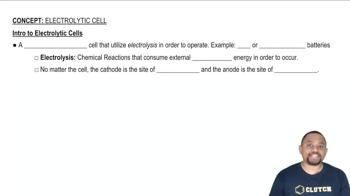
Electrolysis is a chemical process that uses electrical energy to drive a non-spontaneous reaction. In this process, an electric current is passed through an electrolyte, causing the decomposition of the compound into its constituent elements. This is crucial for understanding how ionic compounds, like potassium bromide, can be separated into their ions when molten and subjected to an electric current.
Video consigliato:
Percorso guidato
01:21
The Electrolytic Cell

Half-Reactions

Half-reactions are the two parts of a redox reaction, representing the oxidation and reduction processes separately. In the context of electrolysis, the oxidation half-reaction occurs at the anode, where anions lose electrons, while the reduction half-reaction occurs at the cathode, where cations gain electrons. Identifying these half-reactions is essential for writing the overall reaction that occurs during the electrolysis of potassium bromide.
Video consigliato:
Percorso guidato
01:49
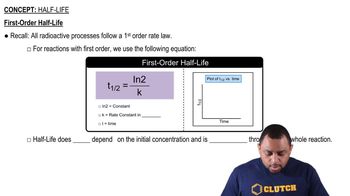
First-Order Half-Life

Ionic Compounds in Molten State

Ionic compounds, such as potassium bromide (KBr), consist of positively and negatively charged ions. When melted, these ions are free to move, allowing them to conduct electricity. Understanding the behavior of these ions in the molten state is vital for predicting the products of electrolysis, as the potassium ions (K+) and bromide ions (Br-) will migrate to the respective electrodes during the process.
Video consigliato:
Percorso guidato
02:11
Ionic Compounds Naming