Ch.2 - Atoms & Elements
Tro - Chemistry: A Molecular Approach 4th Edition
Tro4th EditionChemistry: A Molecular ApproachISBN: 9780134112831Non è quello che usi tu?Cambia libro di testo
Capitolo 2, Problema 45b

On a dry day, your body can accumulate static charge from walking across a carpet or from brushing your hair. If your body develops a charge of -15 µC (microcoulombs), what is their collective mass?

Guida verificata passo dopo passo
1
Identify the charge given in the problem, which is -15 mC (microcoulombs). Note that 1 microcoulomb (mC) equals \$1 imes 10^{-6}$ coulombs (C).
Recognize that the charge carriers in the human body are primarily electrons. The charge of one electron is approximately $-1.602 imes 10^{-19}$ coulombs.
Calculate the number of electrons corresponding to a total charge of -15 mC. Use the formula: Number of electrons = Total charge / Charge of one electron.
Determine the mass of one electron, which is approximately \$9.109 imes 10^{-31}$ kilograms.
Calculate the total mass of the electrons by multiplying the number of electrons by the mass of one electron.

Risposta video verificata per un problema simile:

Questa soluzione video è stata consigliata dai nostri tutor come utile per risolvere questo problema.
Durata del video:
3m

Concetti chiave

Ecco i concetti essenziali che devi comprendere per rispondere correttamente alla domanda.

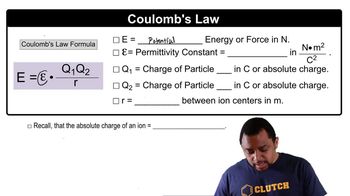
Coulomb's Law

Coulomb's Law describes the electrostatic force between charged objects. It states that the force is directly proportional to the product of the charges and inversely proportional to the square of the distance between them. This principle is fundamental in understanding how static charges interact, which is relevant when considering the accumulation of charge on the body.
Video consigliato:
Percorso guidato
01:15
Coulomb's Law Concept 2

Charge and Mass Relationship

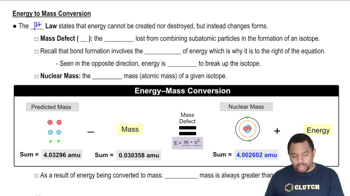
The relationship between charge and mass can be explored through the concept of charge-to-mass ratio. While charge itself does not have mass, the energy associated with a charge can be related to mass via Einstein's equation, E=mc². This concept is crucial for calculating the effective mass of a charged object based on its electric potential energy.
Video consigliato:

Microcoulombs to Mass Conversion

To find the mass associated with a given charge, one can use the energy stored in the electric field created by the charge. The conversion involves calculating the energy using the charge and potential difference, then applying the mass-energy equivalence principle. This process allows for the determination of the mass equivalent of the static charge accumulated on the body.
Video consigliato:
Percorso guidato
04:12
Energy to Mass Conversion
Pratica correlata
Domanda del libro di testo

How many electrons are necessary to produce a charge of -1.0 C? What is the mass of this many electrons?

1766
views
2
rank
3
comments

Domanda del libro di testo

Which statements about subatomic particles are true? a. If an atom has an equal number of protons and electrons, it will be charge-neutral. b. Electrons are attracted to protons. c. Electrons are much lighter than neutrons. d. Protons have twice the mass of neutrons.

3004
views
1
rank
Domanda del libro di testo

Which statements about subatomic particles are false? a. Protons and electrons have charges of the same magnitude but opposite sign. b. Protons have about the same mass as neutrons. c. Some atoms don't have any protons. d. Protons and neutrons have charges of the same magnitude but opposite signs.

2256
views
1
rank
1
comments
Domanda del libro di testo

On a dry day, your body can accumulate static charge from walking across a carpet or from brushing your hair. If your body develops a charge of -15 µC (microcoulombs), how many excess electrons has it acquired?

749
views
Domanda del libro di testo

Imagine a unit of charge called the zorg. A chemist performs the oil drop experiment and measures the charge of each drop in zorgs. Based on the results shown here, what is the charge of the electron in zorgs (z)? How many electrons are in each drop?

Drop # Charge

A –4.8×10⁻⁹ z

B –9.6×10⁻⁹ z

C –6.4×10⁻⁹ z

D –12.8×10⁻⁹ z

3189
views
3
comments
Domanda del libro di testo

A chemist in an imaginary universe, where electrons have a different charge than they do in our universe, performs the Millikan oil drop experiment to measure the electron's charge. The charges of several drops are recorded here. What is the charge of the electron in this imaginary universe?

Drop # Charge

A –6.9×10⁻¹⁹ C

B –9.2×10⁻¹⁹ C

C –11.5×10⁻¹⁹ C

D –4.6×10⁻¹⁹ C

2325
views
3
comments