Ch.2 - Atoms & Elements
Tro - Chemistry: A Molecular Approach 4th Edition
Tro4th EditionChemistry: A Molecular ApproachISBN: 9780134112831Non è quello che usi tu?Cambia libro di testo
Capitolo 2, Problema 95

A 7.83 g sample of HCN contains 0.290 g of H and 4.06 g of N. Find the mass of carbon in a sample of HCN with a mass of 3.37 g.

Guida verificata passo dopo passo
1
Determine the total mass of the original sample of HCN, which is given as 7.83 g.
Calculate the mass of carbon in the original sample by subtracting the mass of hydrogen (0.290 g) and nitrogen (4.06 g) from the total mass of the sample.
Find the fraction of carbon in the original sample by dividing the mass of carbon by the total mass of the sample.
Use the fraction of carbon to determine the mass of carbon in the new sample by multiplying this fraction by the mass of the new sample, which is 3.37 g.
This result gives you the mass of carbon in the 3.37 g sample of HCN.

Risposta video verificata per un problema simile:

Questa soluzione video è stata consigliata dai nostri tutor come utile per risolvere questo problema.
Durata del video:
4m

Concetti chiave

Ecco i concetti essenziali che devi comprendere per rispondere correttamente alla domanda.

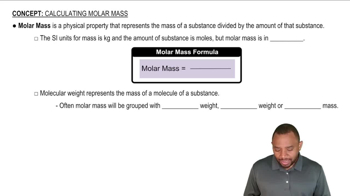
Molar Mass and Composition

Understanding the molar mass of compounds is essential in stoichiometry. HCN consists of hydrogen (H), carbon (C), and nitrogen (N), and knowing the mass contributions of each element allows for calculations of their proportions in different sample sizes.
Video consigliato:
Percorso guidato
02:11
Molar Mass Concept

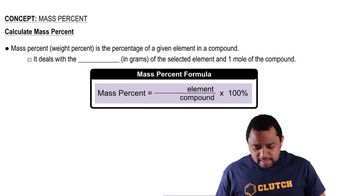
Mass Percent Composition

Mass percent composition is the percentage by mass of each element in a compound. It is calculated by dividing the mass of the element by the total mass of the compound and multiplying by 100. This concept is crucial for determining the mass of carbon in a different sample size based on the known composition.
Video consigliato:
Percorso guidato
00:38
Mass Percent Calculation

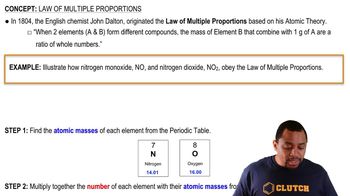
Proportional Relationships

Proportional relationships allow us to scale the mass of an element from one sample size to another. By establishing the ratio of the mass of carbon in the original sample to the total mass, we can apply this ratio to find the mass of carbon in a new sample size, maintaining the same composition.
Video consigliato:
Percorso guidato
03:32
Law of Multiple Proportions