Ch.2 - Atoms & Elements
Tro - Chemistry: A Molecular Approach 4th Edition
Tro4th EditionChemistry: A Molecular ApproachISBN: 9780134112831Non è quello che usi tu?Cambia libro di testo
Capitolo 2, Problema 87

Calculate the number of atoms in each sample. a. 5.18 g P

Guida verificata passo dopo passo
1
Determine the molar mass of phosphorus (P) from the periodic table.
Use the formula: number of moles = mass (g) / molar mass (g/mol) to calculate the moles of phosphorus.
Use Avogadro's number (6.022 x 10^23 atoms/mol) to convert moles of phosphorus to atoms.
Multiply the number of moles by Avogadro's number to find the total number of atoms.
Ensure all units cancel appropriately, leaving you with the number of atoms as the final unit.

Risposta video verificata per un problema simile:

Questa soluzione video è stata consigliata dai nostri tutor come utile per risolvere questo problema.
Durata del video:
2m

Concetti chiave

Ecco i concetti essenziali che devi comprendere per rispondere correttamente alla domanda.

Molar Mass

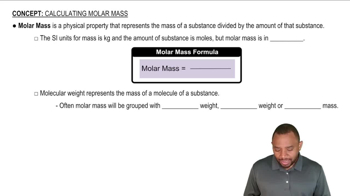
Molar mass is the mass of one mole of a substance, typically expressed in grams per mole (g/mol). For phosphorus (P), the molar mass is approximately 30.97 g/mol. This value is essential for converting grams of a substance to moles, which is a necessary step in determining the number of atoms in a sample.
Video consigliato:
Percorso guidato
02:11
Molar Mass Concept

Avogadro's Number

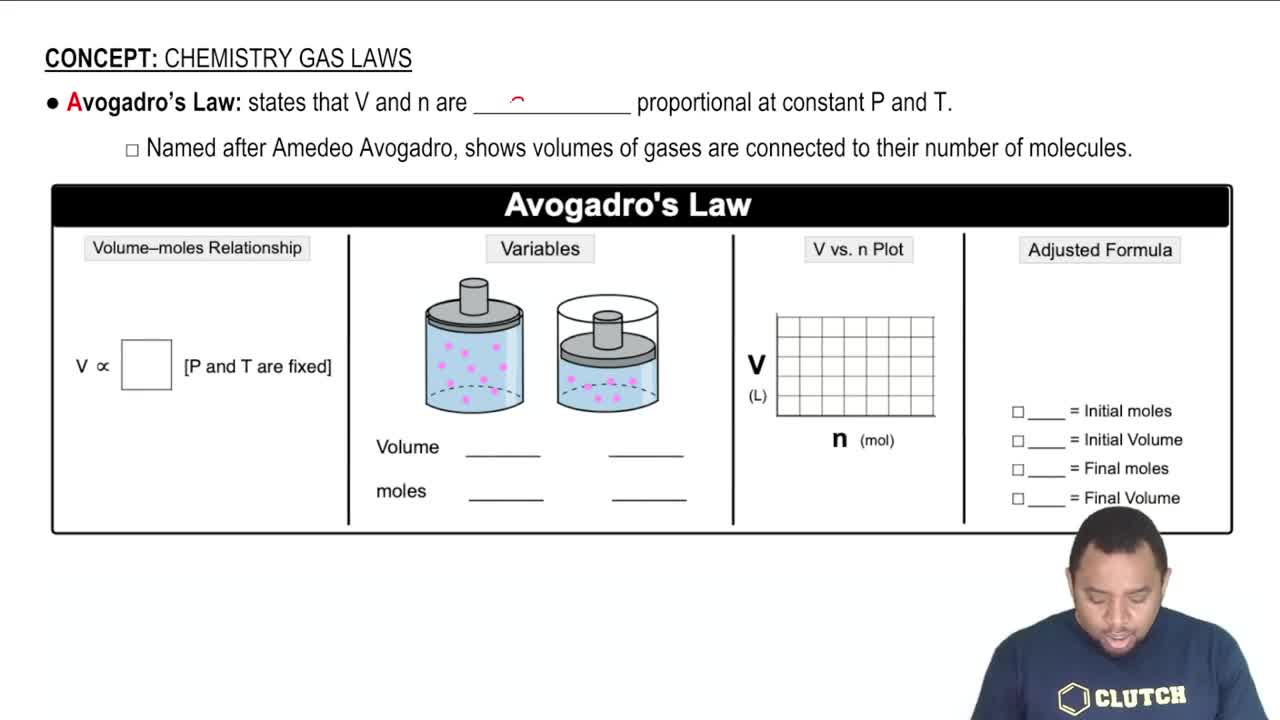
Avogadro's number, approximately 6.022 x 10²³, is the number of atoms, ions, or molecules in one mole of a substance. This constant allows chemists to relate the macroscopic scale of substances (grams) to the microscopic scale (individual atoms or molecules). It is crucial for calculating the total number of atoms in a given mass of an element.
Video consigliato:

Conversion from Grams to Atoms

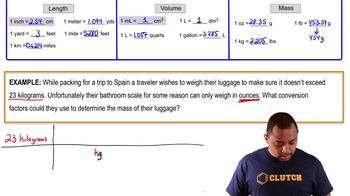
To find the number of atoms in a sample, one must first convert the mass of the sample to moles using the molar mass, and then multiply the number of moles by Avogadro's number. This two-step conversion is fundamental in stoichiometry, allowing for the quantification of particles in a chemical sample based on its mass.
Video consigliato:
Percorso guidato
03:45
Weight Conversion Example