Ch.2 - Atoms & Elements
Tro - Chemistry: A Molecular Approach 4th Edition
Tro4th EditionChemistry: A Molecular ApproachISBN: 9780134112831Non è quello che usi tu?Cambia libro di testo
Capitolo 2, Problema 100

Naturally occurring iodine has an atomic mass of 126.9045 amu. A 12.3849 g sample of iodine is accidentally contaminated with an additional 1.00070 g of 129I, a synthetic radioisotope of iodine used in the treatment of certain diseases of the thyroid gland. The mass of 129I is 128.9050 amu. Find the apparent 'atomic mass' of the contaminated iodine.

Guida verificata passo dopo passo
1
Calculate the total mass of the contaminated iodine sample by adding the mass of the naturally occurring iodine and the mass of the added 129I isotope.
Determine the number of moles of naturally occurring iodine (127I) using its given mass and atomic mass unit (amu). Use the formula: moles = mass (g) / atomic mass (amu).
Calculate the number of moles of the 129I isotope using its given mass and atomic mass unit (amu) with the same formula as in step 2.
Find the total moles of iodine in the sample by adding the moles of 127I and the moles of 129I.
Calculate the apparent atomic mass of the contaminated iodine sample by dividing the total mass of the sample by the total moles of iodine. Use the formula: apparent atomic mass = total mass (g) / total moles.

Risposta video verificata per un problema simile:

Questa soluzione video è stata consigliata dai nostri tutor come utile per risolvere questo problema.
Durata del video:
3m

Concetti chiave

Ecco i concetti essenziali che devi comprendere per rispondere correttamente alla domanda.

Atomic Mass

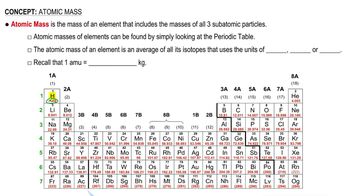
Atomic mass is the weighted average mass of an element's isotopes, measured in atomic mass units (amu). It reflects both the mass and the relative abundance of each isotope in a naturally occurring sample. For example, iodine has isotopes with different masses, and the atomic mass of 126.9045 amu accounts for the contributions of these isotopes based on their natural abundance.
Video consigliato:

Isotopes

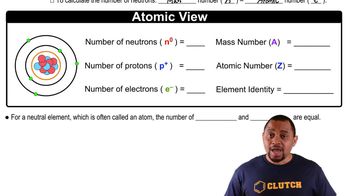
Isotopes are variants of a chemical element that have the same number of protons but different numbers of neutrons, resulting in different atomic masses. For iodine, the stable isotope is 127I, while 129I is a radioactive isotope. Understanding isotopes is crucial for calculating the average atomic mass when a sample contains multiple isotopes, as in the case of the contaminated iodine.
Video consigliato:

Weighted Average Calculation

The weighted average calculation is used to determine the average atomic mass of an element when multiple isotopes are present. This involves multiplying the mass of each isotope by its relative abundance (in terms of mass) and summing these products. In the context of the contaminated iodine sample, this calculation will yield the apparent atomic mass by considering both the natural iodine and the added synthetic isotope.
Video consigliato:
Percorso guidato
02:42
Average Rate Calculation Example