Ch.2 - Atoms & Elements
Tro - Chemistry: A Molecular Approach 4th Edition
Tro4th EditionChemistry: A Molecular ApproachISBN: 9780134112831Non è quello che usi tu?Cambia libro di testo
Capitolo 2, Problema 123

Pure gold is usually too soft for jewelry, so it is often alloyed with other metals. How many gold atoms are in an 0.255-ounce, 18 K gold bracelet? (18 K gold is 75% gold by mass.)

Guida verificata passo dopo passo
1
Convert the mass of the bracelet from ounces to grams using the conversion factor: 1 ounce = 28.3495 grams.
Calculate the mass of gold in the bracelet by multiplying the total mass of the bracelet by the percentage of gold (75%).
Convert the mass of gold from grams to moles using the molar mass of gold (Au), which is approximately 197 g/mol.
Use Avogadro's number (6.022 x 10^23 atoms/mol) to convert the moles of gold to the number of gold atoms.
Compile the steps to ensure the logical flow from mass conversion to determining the number of atoms.

Risposta video verificata per un problema simile:

Questa soluzione video è stata consigliata dai nostri tutor come utile per risolvere questo problema.
Durata del video:
3m

Concetti chiave

Ecco i concetti essenziali che devi comprendere per rispondere correttamente alla domanda.

Molar Mass

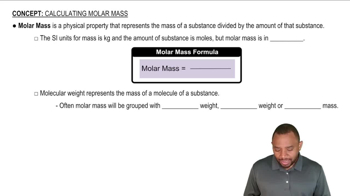
Molar mass is the mass of one mole of a substance, typically expressed in grams per mole (g/mol). For gold (Au), the molar mass is approximately 197 g/mol. Understanding molar mass is essential for converting between grams and moles, which is necessary for calculating the number of atoms in a given mass of gold.
Video consigliato:
Percorso guidato
02:11
Molar Mass Concept

Alloy Composition

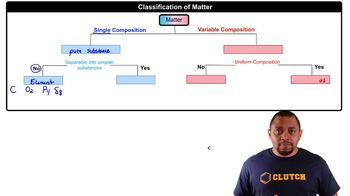
An alloy is a mixture of two or more elements, where at least one is a metal. In the case of 18 K gold, it contains 75% gold by mass and 25% other metals. This composition affects the properties of the material, such as hardness and color, and is crucial for determining the actual mass of gold in the bracelet.
Video consigliato:
Percorso guidato
04:19
Matter Composition

Avogadro's Number

Avogadro's number, approximately 6.022 x 10^23, is the number of atoms, ions, or molecules in one mole of a substance. This constant allows chemists to relate the mass of a substance to the number of particles it contains. In this problem, it is used to convert the number of moles of gold into the actual number of gold atoms present in the bracelet.
Video consigliato:
Pratica correlata
Domanda del libro di testo

Silver is composed of two naturally occurring isotopes: Ag-107 (51.839%) and Ag-109. The ratio of the masses of the two isotopes is 1.0187. What is the mass of Ag-107?

3328
views

Domanda del libro di testo

The U.S. Environmental Protection Agency (EPA) sets limits on healthful levels of air pollutants. The maximum level that the EPA considers safe for lead air pollution is 1.5 µg/m3. If your lungs were filled with air containing this level of lead, how many lead atoms would be in your lungs? (Assume a total lung volume of 5.50 L.)

1471
views
Domanda del libro di testo

Let a triangle represent atoms of element A and a circle represent atoms of element B. b. Draw an atomic view of the compound AB in a liquid state (molecules close together).

148
views
Domanda del libro di testo

A volatile liquid (one that easily evaporates) is put into a jar and the jar is then sealed. Does the mass of the sealed jar and its contents change upon the vaporization of the liquid?

119
views
Domanda del libro di testo

Naturally occurring chlorine is composed of two isotopes: 75.76% Cl-35 (mass 34.9688 amu) and 24.24% Cl-37 (mass 36.9659 amu). Naturally occurring oxygen is composed of three isotopes: 99.757% O-16 (mass 15.9949 amu), 0.038% O-17 (mass 16.9991 amu), and 0.205% O-18 (mass 17.9991 amu). The compound dichlorine monoxide is composed of two chlorine atoms and one oxygen atom bonded together to form the Cl2O molecule. How many Cl2O molecules of different masses naturally exist? Give the masses of the three most abundant Cl2O molecules.

2327
views