
Ch.2 - Atoms & Elements
Tro - Chemistry: A Molecular Approach 4th Edition
Tro4th EditionChemistry: A Molecular ApproachISBN: 9780134112831Non è quello che usi tu?Cambia libro di testo
Capitolo 2, Problema 32

Two samples of sodium chloride are decomposed into their constituent elements. One sample produces 6.98 g of sodium and 10.7 g of chlorine, and the other sample produces 11.2 g of sodium and 17.3 g of chlorine. Are these results consistent with the law of definite proportions? Explain your answer.

Guida verificata passo dopo passo
1
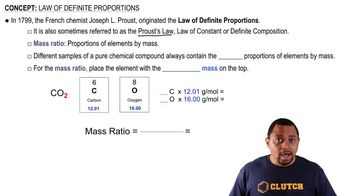
Identify the law of definite proportions, which states that a chemical compound always contains exactly the same proportion of elements by mass.
Calculate the mass ratio of sodium to chlorine for the first sample: \( \frac{6.98 \, \text{g Na}}{10.7 \, \text{g Cl}} \).
Calculate the mass ratio of sodium to chlorine for the second sample: \( \frac{11.2 \, \text{g Na}}{17.3 \, \text{g Cl}} \).
Compare the two mass ratios calculated in the previous steps to determine if they are the same or very close, which would indicate consistency with the law of definite proportions.
Conclude whether the results are consistent with the law of definite proportions based on the comparison of the mass ratios.

Concetti chiave

Ecco i concetti essenziali che devi comprendere per rispondere correttamente alla domanda.

Law of Definite Proportions

The Law of Definite Proportions states that a chemical compound always contains its component elements in fixed ratio by mass, regardless of the amount of the compound or its source. For example, in sodium chloride (NaCl), the ratio of sodium to chlorine by mass should remain constant, typically around 1:1.39, regardless of how the compound is prepared.
Video consigliato:
Percorso guidato
02:48
Law of Definite Proportions

Mass Ratio Calculation

To determine if the results are consistent with the Law of Definite Proportions, one must calculate the mass ratio of sodium to chlorine for each sample. This involves dividing the mass of sodium by the mass of chlorine for both samples and comparing the ratios. If the ratios are equal or very close, the results support the law; if they differ significantly, they do not.
Video consigliato:
Percorso guidato
02:14
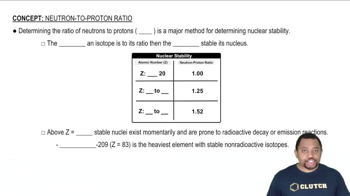
Neutron-Proton Ratio

Stoichiometry

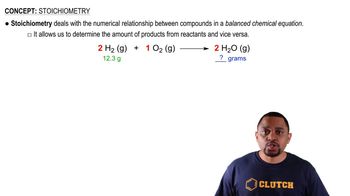
Stoichiometry is the branch of chemistry that deals with the quantitative relationships between the reactants and products in a chemical reaction. It allows chemists to predict the amounts of substances consumed and produced in a reaction based on balanced chemical equations. Understanding stoichiometry is essential for analyzing the results of the sodium chloride decomposition in relation to the Law of Definite Proportions.
Video consigliato:
Percorso guidato
01:16
Stoichiometry Concept
Pratica correlata
Domanda del libro di testo

Upon decomposition, one sample of magnesium fluoride produces 1.65 kg of magnesium and 2.57 kg of fluorine. A second sample produces 1.32 kg of magnesium. How much fluorine (in grams) does the second sample produce?

3159
views
1
rank
Domanda del libro di testo

The mass ratio of sodium to fluorine in sodium fluoride is 1.21:1. A sample of sodium fluoride produces 28.8 g of sodium upon decomposition. How much fluorine (in grams) forms?

2564
views
5
rank
Domanda del libro di testo

A hydrogen-filled balloon is ignited and 1.50 g of hydrogen is reacted with 12.0 g of oxygen. How many grams of water vapor form? (Assume that water vapor is the only product.)

2488
views
Domanda del libro di testo

An automobile gasoline tank holds 21 kg of gasoline. When the gasoline burns, 84 kg of oxygen is consumed, and carbon dioxide and water are produced. What is the total combined mass of carbon dioxide and water that is produced?

2737
views
Domanda del libro di testo

Two different compounds containing osmium and oxygen have the following masses of oxygen per gram of osmium: 0.168 and 0.3369 g. Show that these amounts are consistent with the law of multiple proportions.

1321
views
4
rank
Domanda del libro di testo

Two samples of carbon tetrachloride are decomposed into their constituent elements. One sample produces 38.9 g of carbon and 448 g of chlorine, and the other sample produces 14.8 g of carbon and 134 g of chlorine. Are these results consistent with the law of definite proportions? Explain your answer.

1279
views
1
rank