
Silicon has three naturally occurring isotopes (Si-28, Si-29, and Si-30). The mass and natural abundance of Si-28 are 27.9769 amu and 92.2%, respectively. The mass and natural abundance of Si-29 are 28.9765 amu and 4.67%, respectively. Find the mass and natural abundance of Si-30.
Ch.2 - Atoms & Elements
Tro4th EditionChemistry: A Molecular ApproachISBN: 9780134112831Non è quello che usi tu?Cambia libro di testo
Capitolo 2, Problema 80
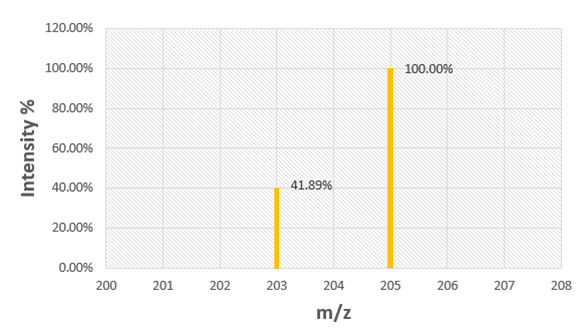
Use the mass spectrum of rubidium to determine the atomic mass of rubidium.

Guida verificata passo dopo passo1
Identify the isotopes of rubidium from the mass spectrum. The m/z values are 203 and 205.
Note the relative intensities of each isotope. For m/z 203, the intensity is 41.89%, and for m/z 205, the intensity is 100%.
Convert the relative intensities to fractional abundances. For m/z 203, the fractional abundance is 41.89 / (41.89 + 100). For m/z 205, the fractional abundance is 100 / (41.89 + 100).
Calculate the weighted average atomic mass of rubidium using the formula: (fractional abundance of isotope 1 * mass of isotope 1) + (fractional abundance of isotope 2 * mass of isotope 2).
Substitute the values into the formula and solve for the atomic mass of rubidium.

Risposta video verificata per un problema simile:
Questa soluzione video è stata consigliata dai nostri tutor come utile per risolvere questo problema.
Durata del video:
3mConcetti chiave
Ecco i concetti essenziali che devi comprendere per rispondere correttamente alla domanda.
Mass Spectrum
A mass spectrum is a graphical representation of the mass-to-charge ratio (m/z) of ions. It displays the relative abundance of each ion detected, allowing chemists to identify the composition of a sample. Peaks in the spectrum correspond to different isotopes or molecular fragments, with their heights indicating the intensity or abundance of each ion.
Video consigliato:
Percorso guidato
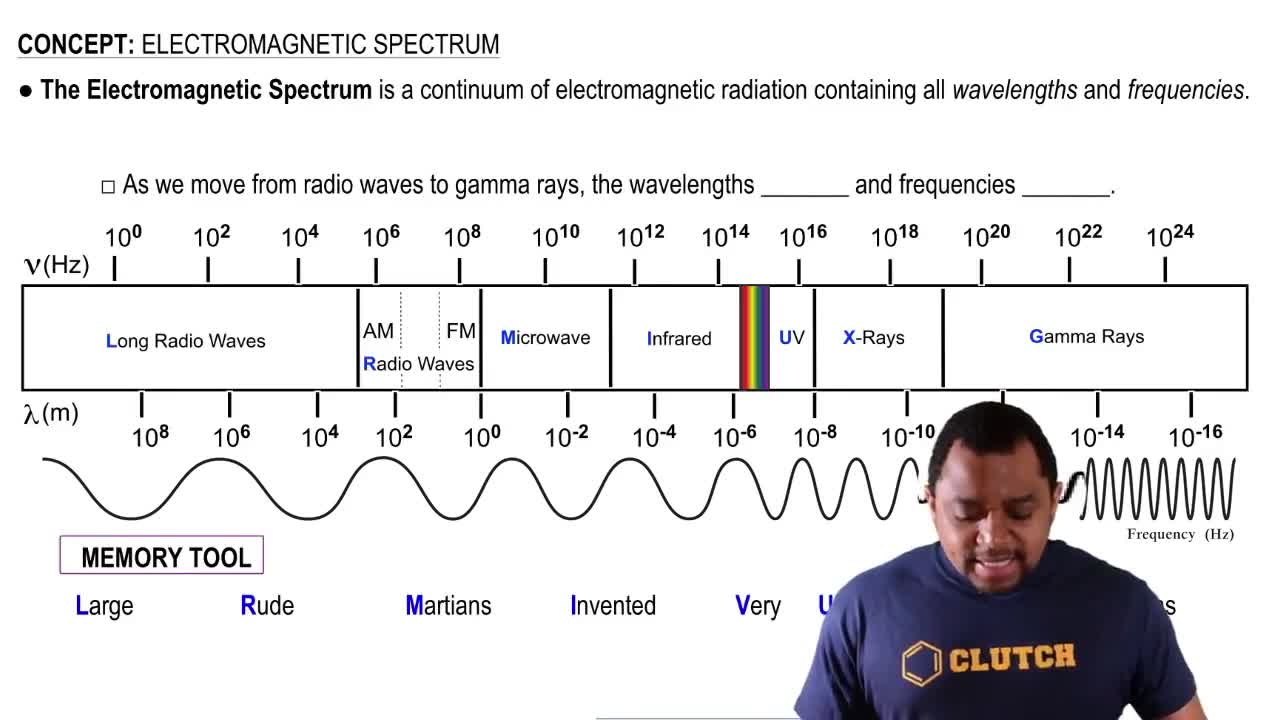
Electromagnetic Spectrum
Atomic Mass
Atomic mass is the weighted average mass of an element's isotopes, measured in atomic mass units (amu). It reflects both the mass and the relative abundance of each isotope present in a sample. To calculate the atomic mass from a mass spectrum, one must consider the m/z values and their corresponding intensity percentages to find a weighted average.
Video consigliato:
Percorso guidato
Atomic Mass
Isotopes
Isotopes are variants of a chemical element that have the same number of protons but different numbers of neutrons, resulting in different atomic masses. For rubidium, the isotopes present in the mass spectrum are typically Rb-203, Rb-204, and Rb-205. Understanding isotopes is crucial for accurately determining the atomic mass from the mass spectrum, as each isotope contributes differently based on its abundance.
Video consigliato:
Percorso guidato
Isotopes
Pratica correlata
Domanda del libro di testo
9413
views
Domanda del libro di testo
How many sulfur atoms are there in 5.52 mol of sulfur?
1811
views
1
rank
Domanda del libro di testo
How many moles of aluminum do 3.7×1024 aluminum atoms represent?
912
views
Domanda del libro di testo
Use the mass spectrum of europium to determine the atomic mass of europium.
686
views
Domanda del libro di testo
What is the amount, in moles, of each elemental sample? a. 11.8 g Ar b. 3.55 g Zn c. 26.1 g Ta d. 0.211 g Li
617
views
Domanda del libro di testo
Bromine has two naturally occurring isotopes (Br-79 and Br-81) and has an atomic mass of 79.904 amu. The mass of Br-81 is 80.9163 amu, and its natural abundance is 49.31%. Calculate the mass and natural abundance of Br-79.
8889
views
3
rank
1
comments
