Ch.2 - Atoms & Elements
Tro - Chemistry: A Molecular Approach 4th Edition
Tro4th EditionChemistry: A Molecular ApproachISBN: 9780134112831Non è quello che usi tu?Cambia libro di testo
Capitolo 2, Problema 84a,b,d

What is the mass, in grams, of each elemental sample? a. 2.3×10⁻³ mol Sb b. 0.0355 mol Ba d. 1.3 mol W

Guida verificata passo dopo passo
1
Identify the molar mass of the element in question, which is antimony (Sb). You can find this value on the periodic table. The molar mass of Sb is approximately 121.76 g/mol.
Use the formula: \( \text{mass} = \text{moles} \times \text{molar mass} \).
Substitute the given number of moles (2.3 \(\times\) 10^{-3} \(\text{ mol}\)) and the molar mass of Sb (121.76 g/mol) into the formula.
Calculate the product of the moles and the molar mass to find the mass in grams.
Ensure the units are consistent and the final answer is expressed in grams.

Risposta video verificata per un problema simile:

Questa soluzione video è stata consigliata dai nostri tutor come utile per risolvere questo problema.
Durata del video:
48s

Concetti chiave

Ecco i concetti essenziali che devi comprendere per rispondere correttamente alla domanda.

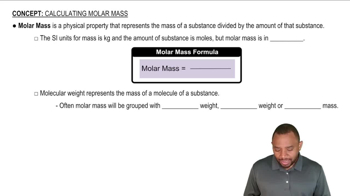
Molar Mass

Molar mass is the mass of one mole of a substance, typically expressed in grams per mole (g/mol). It is calculated by summing the atomic masses of all the atoms in a molecule or formula unit. For example, the molar mass of antimony (Sb) is approximately 121.76 g/mol, which is essential for converting moles to grams.
Video consigliato:
Percorso guidato
02:11
Molar Mass Concept

Conversion of Moles to Grams

To find the mass of a substance in grams from its amount in moles, you multiply the number of moles by the molar mass of the substance. The formula used is: mass (g) = moles × molar mass (g/mol). This conversion is fundamental in stoichiometry and allows chemists to relate quantities of reactants and products in chemical reactions.
Video consigliato:
Percorso guidato
02:28
Mass and Moles Conversion

Significant Figures

Significant figures are the digits in a number that contribute to its precision. In scientific calculations, it is important to maintain the correct number of significant figures to reflect the precision of the measurements. For example, in the value 2.3 × 10^-3 mol, there are two significant figures, which should be considered when calculating the final mass in grams.
Video consigliato:
Percorso guidato
01:09
Significant Figures Example