Ch.2 - Atoms & Elements
Tro - Chemistry: A Molecular Approach 4th Edition
Tro4th EditionChemistry: A Molecular ApproachISBN: 9780134112831Non è quello che usi tu?Cambia libro di testo
Capitolo 2, Problema 69

Which pair of elements do you expect to be most similar? Why? a. N and Ni b. Mo and Sn c. Na and Mg d. Cl and F e. Si and P

Guida verificata passo dopo passo
1
Step 1: Understand the concept of periodic trends and element similarity. Elements in the same group (column) of the periodic table have similar properties because they have the same number of valence electrons.
Step 2: Analyze the given pairs of elements to determine if they belong to the same group.
Step 3: Check pair a. N (Nitrogen) and Ni (Nickel). N is in group 15, while Ni is in group 10. They are not in the same group.
Step 4: Check pair d. Cl (Chlorine) and F (Fluorine). Cl is in group 17, and F is also in group 17. They are in the same group and are both halogens.
Step 5: Conclude that Cl and F are the most similar pair because they are in the same group and share similar chemical properties as halogens.

Risposta video verificata per un problema simile:

Questa soluzione video è stata consigliata dai nostri tutor come utile per risolvere questo problema.
Durata del video:
4m

Concetti chiave

Ecco i concetti essenziali che devi comprendere per rispondere correttamente alla domanda.

Periodic Trends

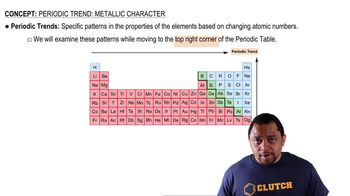
Periodic trends refer to the predictable patterns in the properties of elements as you move across or down the periodic table. These trends include atomic radius, ionization energy, and electronegativity, which help in understanding the similarities and differences between elements. For example, elements in the same group often exhibit similar chemical properties due to their similar valence electron configurations.
Video consigliato:
Percorso guidato
00:38
Periodic Trends

Element Classification

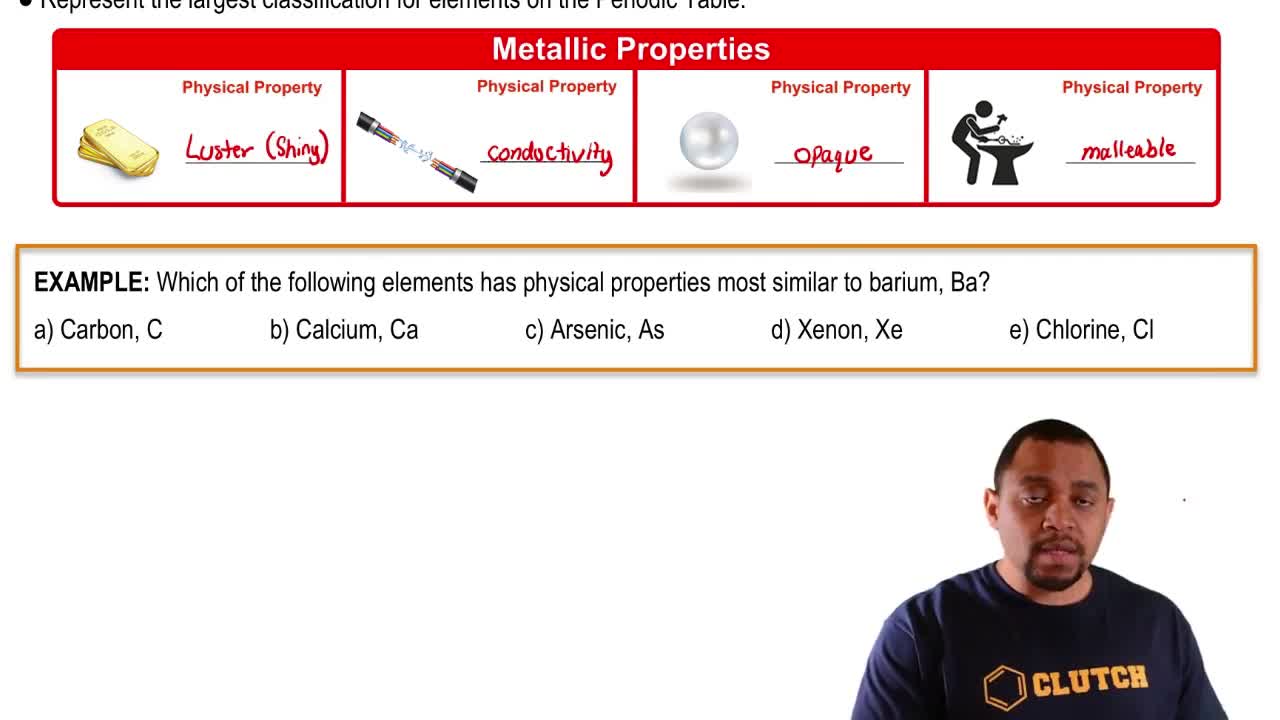
Elements are classified into categories such as metals, nonmetals, and metalloids based on their physical and chemical properties. Metals, for instance, are typically good conductors of heat and electricity, while nonmetals are more likely to gain electrons during chemical reactions. Understanding these classifications aids in predicting how elements will behave in reactions and their similarities with other elements.
Video consigliato:
Percorso guidato
01:39
Element Classification Example

Chemical Similarity

Chemical similarity between elements often arises from their position in the periodic table, particularly within the same group or period. Elements in the same group have the same number of valence electrons, leading to similar reactivity and bonding characteristics. For example, halogens like chlorine (Cl) and fluorine (F) are both highly reactive nonmetals, making them more similar than elements from different groups.
Video consigliato:
Percorso guidato
03:31
Chemical Properties