A helium nucleus has two protons and two neutrons. How many electrons does it take to equal the mass of a helium nucleus?
Ch.2 - Atoms & Elements
Tro4th EditionChemistry: A Molecular ApproachISBN: 9780134112831Non è quello che usi tu?Cambia libro di testo
Capitolo 2, Problema 51a
Write isotopic symbols in the form X-A (e.g., C-13) for each isotope. a. the silver isotope with 60 neutrons
Guida verificata passo dopo passo1
Identify the element: Silver is represented by the symbol 'Ag'.
Determine the atomic number of silver: Silver (Ag) has an atomic number of 47, which means it has 47 protons.
Calculate the mass number: The mass number is the sum of protons and neutrons. For this isotope, it has 47 protons and 60 neutrons, so the mass number is 47 + 60.
Write the isotopic symbol: Combine the element symbol with the mass number to write the isotopic symbol in the form X-A.
The isotopic symbol for the silver isotope with 60 neutrons is Ag-107.

Risposta video verificata per un problema simile:
Questa soluzione video è stata consigliata dai nostri tutor come utile per risolvere questo problema.
Durata del video:
3mConcetti chiave
Ecco i concetti essenziali che devi comprendere per rispondere correttamente alla domanda.
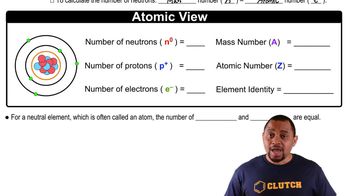
Isotopes
Isotopes are variants of a particular chemical element that have the same number of protons but different numbers of neutrons. This difference in neutron count results in varying atomic masses. For example, carbon-12 and carbon-14 are isotopes of carbon, with 6 and 8 neutrons, respectively. Isotopes can be stable or radioactive, influencing their applications in fields like medicine and archaeology.
Video consigliato:
Percorso guidato
Isotopes
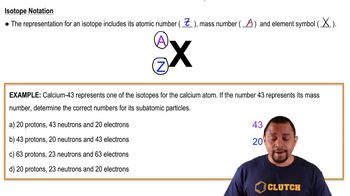
Isotopic Notation
Isotopic notation is a way to represent isotopes using the format X-A, where 'X' is the chemical symbol of the element and 'A' is the mass number, which is the sum of protons and neutrons. For instance, in the notation C-14, 'C' represents carbon, and '14' indicates that the isotope has a total of 14 nucleons (6 protons and 8 neutrons). This notation helps in identifying specific isotopes and their properties.
Video consigliato:
Percorso guidato
Isotope Notation Example
Mass Number
The mass number of an isotope is the total count of protons and neutrons in its nucleus. It is crucial for distinguishing between different isotopes of the same element. For example, if silver has 47 protons and 60 neutrons, its mass number would be 107 (47 protons + 60 neutrons), leading to the isotopic symbol Ag-107. Understanding mass numbers is essential for calculations involving atomic mass and nuclear stability.
Video consigliato:
Percorso guidato
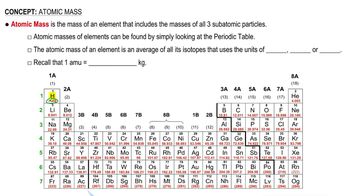
Atomic Mass
Pratica correlata
Domanda del libro di testo
3361
views
Domanda del libro di testo
How many electrons does it take to equal the mass of a proton?
1334
views
Domanda del libro di testo
Write isotopic symbols in the form X-A (e.g., C-13) for each isotope. b. the silver isotope with 62 neutrons
550
views
Domanda del libro di testo
Which statements about subatomic particles are false? a. Protons and electrons have charges of the same magnitude but opposite sign. b. Protons have about the same mass as neutrons. c. Some atoms don't have any protons. d. Protons and neutrons have charges of the same magnitude but opposite signs.
2256
views
1
rank
1
comments
Domanda del libro di testo
Write isotopic symbols in the form X-A (e.g., C-13) for each isotope. c. the uranium isotope with 146 neutrons
1365
views
Domanda del libro di testo
Write isotopic symbols in the form X-A (e.g., C-13) for each isotope. d. the hydrogen isotope with one neutron
1101
views