Ch.20 - Radioactivity and Nuclear Chemistry
Tro - Chemistry: A Molecular Approach 4th Edition
Tro4th EditionChemistry: A Molecular ApproachISBN: 9780134112831Non è quello che usi tu?Cambia libro di testo
Capitolo 20, Problema 66

A typical home uses approximately 1.0⨉103 kWh of energy per month. If the energy came from a nuclear reaction, what mass would have to be converted to energy per year to meet the energy needs of the home?

Guida verificata passo dopo passo
1
Identify the total energy consumption per year by multiplying the monthly energy usage by 12 months: \(1.0 \times 10^3 \text{kWh/month} \times 12 \text{ months/year}\).
Convert the energy from kilowatt-hours (kWh) to joules (J) using the conversion factor: \(1 \text{ kWh} = 3.6 \times 10^6 \text{ J}\).
Use Einstein's mass-energy equivalence formula \(E = mc^2\) to find the mass \(m\) that would be converted to energy, where \(E\) is the energy in joules and \(c\) is the speed of light \(3.0 \times 10^8 \text{ m/s}\).
Rearrange the formula to solve for mass \(m\): \(m = \frac{E}{c^2}\).
Substitute the calculated energy \(E\) and the speed of light \(c\) into the equation to find the mass \(m\) in kilograms.

Risposta video verificata per un problema simile:

Questa soluzione video è stata consigliata dai nostri tutor come utile per risolvere questo problema.
Durata del video:
3m

Concetti chiave

Ecco i concetti essenziali che devi comprendere per rispondere correttamente alla domanda.

Energy-Mass Equivalence

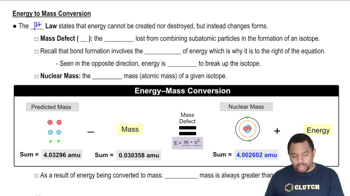
Energy-mass equivalence is a principle derived from Einstein's theory of relativity, expressed by the equation E=mc². This equation states that energy (E) and mass (m) are interchangeable; a small amount of mass can be converted into a large amount of energy due to the speed of light squared (c²) being a very large number. This concept is crucial for understanding how mass can be converted to meet energy needs.
Video consigliato:
Percorso guidato
04:12
Energy to Mass Conversion

Nuclear Energy

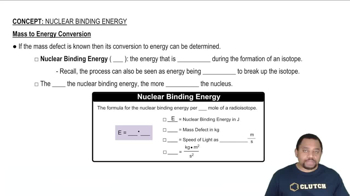
Nuclear energy is the energy released during nuclear reactions, such as fission or fusion. In fission, heavy atomic nuclei split into smaller parts, releasing energy, while fusion involves light nuclei combining to form a heavier nucleus. Understanding nuclear energy is essential for calculating how much mass must be converted to meet energy demands, as it provides a context for the energy output from nuclear reactions.
Video consigliato:
Percorso guidato
02:06
Nuclear Binding Energy

Energy Consumption Calculations

Energy consumption calculations involve determining the total energy used over a specific period, often measured in kilowatt-hours (kWh). In this scenario, the monthly energy usage of 1.0⨉10³ kWh must be converted to an annual figure to assess the total energy requirement. This calculation is fundamental for quantifying the energy needs of a household and subsequently relating it to the mass of fuel required for energy production.
Video consigliato:
Percorso guidato
01:51
Gibbs Free Energy of Reactions