A typical nuclear reactor produces about 1.0 MW of power per day. What is the minimum rate of mass loss required to produce this much energy?
Guida verificata passo dopo passo
1
Understand that the problem involves converting energy to mass using Einstein's mass-energy equivalence principle, which is given by the equation: \(E = mc^2\), where \(E\) is energy, \(m\) is mass, and \(c\) is the speed of light in a vacuum (\(3.00 \times 10^8\) m/s).
Convert the power output from megawatts to joules per day. Since 1 MW = \(1 \times 10^6\) watts and 1 watt = 1 joule/second, calculate the total energy produced in one day (24 hours).
Calculate the total energy in joules by multiplying the power in watts by the number of seconds in a day (24 hours * 60 minutes/hour * 60 seconds/minute).
Rearrange the mass-energy equivalence equation to solve for mass: \(m = \frac{E}{c^2}\).
Substitute the total energy calculated in joules and the speed of light into the equation to find the minimum rate of mass loss required to produce the given energy.
Risposta video verificata per un problema simile:
Questa soluzione video è stata consigliata dai nostri tutor come utile per risolvere questo problema.
Durata del video:
4m
Guarda un video:
0 Commenti
Concetti chiave
Ecco i concetti essenziali che devi comprendere per rispondere correttamente alla domanda.
Mass-Energy Equivalence
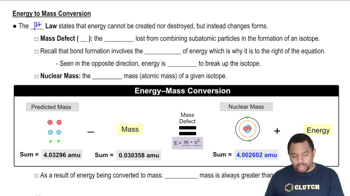
Mass-energy equivalence, expressed by Einstein's equation E=mc², states that mass can be converted into energy and vice versa. In nuclear reactions, a small amount of mass is lost and converted into a significant amount of energy, which is crucial for understanding how nuclear reactors generate power.
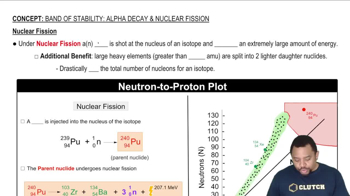
Nuclear fission is the process by which a heavy nucleus splits into smaller nuclei, releasing energy in the form of heat. This reaction is the primary mechanism in nuclear reactors, where controlled fission of isotopes like uranium-235 or plutonium-239 produces the energy needed to generate electricity.
Power is the rate at which energy is produced or consumed, typically measured in watts (W). In the context of the question, understanding how to convert the daily energy output of the reactor (1.0 MW per day) into a consistent rate of mass loss requires knowledge of energy units and their relationship to mass through the mass-energy equivalence principle.


 Guida verificata passo dopo passo
 04:12
04:12