Ch.20 - Radioactivity and Nuclear Chemistry
Tro - Chemistry: A Molecular Approach 4th Edition
Tro4th EditionChemistry: A Molecular ApproachISBN: 9780134112831Non è quello che usi tu?Cambia libro di testo
Capitolo 20, Problema 38

Determine whether or not each nuclide is likely to be stable. State your reasons. a. Ti-48 b. Cr-63 c. Sn-102 d. Y-88

Guida verificata passo dopo passo
1
To determine the stability of a nuclide, consider the neutron-to-proton (N/Z) ratio. A stable nuclide typically has an N/Z ratio close to 1 for lighter elements and slightly higher for heavier elements.
For Ti-48: Titanium (Ti) has an atomic number of 22, meaning it has 22 protons. Ti-48 has 48 - 22 = 26 neutrons. Calculate the N/Z ratio: \( \frac{26}{22} \). Compare this ratio to the typical stable range for elements around titanium.
For Cr-63: Chromium (Cr) has an atomic number of 24, meaning it has 24 protons. Cr-63 has 63 - 24 = 39 neutrons. Calculate the N/Z ratio: \( \frac{39}{24} \). Check if this ratio falls within the stable range for elements around chromium.
For Sn-102: Tin (Sn) has an atomic number of 50, meaning it has 50 protons. Sn-102 has 102 - 50 = 52 neutrons. Calculate the N/Z ratio: \( \frac{52}{50} \). Determine if this ratio is typical for stable isotopes of tin.
For Y-88: Yttrium (Y) has an atomic number of 39, meaning it has 39 protons. Y-88 has 88 - 39 = 49 neutrons. Calculate the N/Z ratio: \( \frac{49}{39} \). Evaluate if this ratio is within the stable range for yttrium isotopes.

Risposta video verificata per un problema simile:

Questa soluzione video è stata consigliata dai nostri tutor come utile per risolvere questo problema.
Durata del video:
1m

Concetti chiave

Ecco i concetti essenziali che devi comprendere per rispondere correttamente alla domanda.

Nuclear Stability

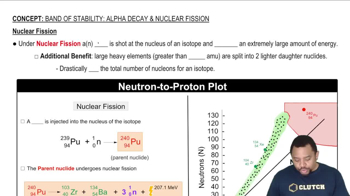
Nuclear stability refers to the ability of a nuclide to remain unchanged over time without undergoing radioactive decay. Stable nuclides have a balanced ratio of protons to neutrons, which minimizes the forces that can lead to instability. Understanding the stability of a nuclide is crucial for predicting its behavior and longevity.
Video consigliato:
Percorso guidato
03:29
Band of Stability: Nuclear Fission

Nuclear Binding Energy

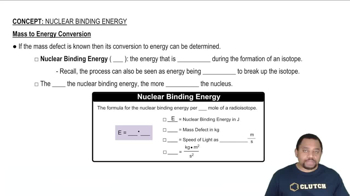
Nuclear binding energy is the energy required to disassemble a nucleus into its constituent protons and neutrons. A higher binding energy indicates a more stable nucleus, as it suggests that the nucleons are held together more tightly. This concept helps in assessing the stability of different isotopes based on their nuclear structure.
Video consigliato:
Percorso guidato
02:06
Nuclear Binding Energy

Magic Numbers

Magic numbers are specific numbers of nucleons (protons or neutrons) that result in particularly stable configurations within a nucleus. These numbers correspond to complete shells of nucleons, leading to enhanced stability. Recognizing magic numbers can aid in predicting the stability of isotopes, as nuclides with these numbers are often more stable.
Video consigliato:
Percorso guidato
00:46
Number of Electrons in Shells