
Ch.20 - Radioactivity and Nuclear Chemistry
Tro - Chemistry: A Molecular Approach 4th Edition
Tro4th EditionChemistry: A Molecular ApproachISBN: 9780134112831Non è quello che usi tu?Cambia libro di testo
Capitolo 20, Problema 76

Suppose a patient is given 1.55 mg of I-131, a beta emitter with a half-life of 8.0 days. Assuming that none of the I-131 is eliminated from the person's body in the first 4.0 hours of treatment, what is the exposure (in Ci) during those first four hours?

Guida verificata passo dopo passo
1
Convert the mass of I-131 from milligrams to grams by using the conversion factor: 1 mg = 0.001 g.
Calculate the number of moles of I-131 using its molar mass (approximately 130.91 g/mol).
Determine the number of atoms of I-131 using Avogadro's number (6.022 x 10^23 atoms/mol).
Use the decay constant formula, \( \lambda = \frac{0.693}{t_{1/2}} \), where \( t_{1/2} \) is the half-life in days, to find the decay constant in terms of hours.
Calculate the activity in curies (Ci) using the formula \( A = \lambda N \), where \( N \) is the number of atoms, and convert the result from disintegrations per second to curies using the conversion factor: 1 Ci = 3.7 x 10^10 disintegrations per second.

Risposta video verificata per un problema simile:

Questa soluzione video è stata consigliata dai nostri tutor come utile per risolvere questo problema.
Durata del video:
9m

Concetti chiave

Ecco i concetti essenziali che devi comprendere per rispondere correttamente alla domanda.

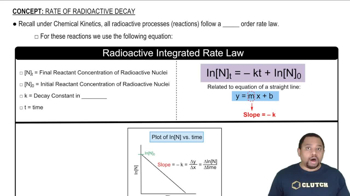
Radioactive Decay

Radioactive decay is the process by which unstable atomic nuclei lose energy by emitting radiation. This decay occurs at a predictable rate characterized by the half-life, which is the time required for half of the radioactive substance to decay. Understanding this concept is crucial for calculating the remaining quantity of a radioactive isotope over time.
Video consigliato:
Percorso guidato
03:00
Rate of Radioactive Decay

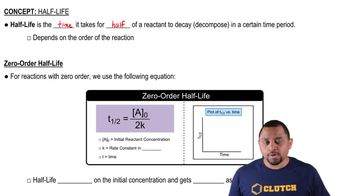
Half-Life

Half-life is a specific time period in which half of a given amount of a radioactive substance will decay. For I-131, the half-life is 8.0 days, meaning that after 8.0 days, only 50% of the original amount will remain. This concept is essential for determining how much of the substance is present at any given time, especially in the context of medical treatments.
Video consigliato:
Percorso guidato
02:17
Zero-Order Half-life

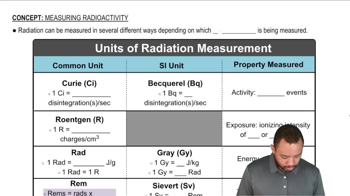
Curie (Ci)

The Curie (Ci) is a unit of radioactivity that measures the rate of decay of radioactive material. One Curie is defined as 3.7 x 10^10 disintegrations per second. In the context of medical treatments, understanding the exposure in Ci helps quantify the amount of radiation a patient is receiving, which is critical for assessing safety and efficacy.
Video consigliato:
Percorso guidato
02:52
Units of Radiation Measurement