Ch.20 - Radioactivity and Nuclear Chemistry
Tro - Chemistry: A Molecular Approach 4th Edition
Tro4th EditionChemistry: A Molecular ApproachISBN: 9780134112831Non è quello che usi tu?Cambia libro di testo
Capitolo 20, Problema 90

The nuclide 6Li reacts with 2H to form two identical particles. Identify the particles.

Guida verificata passo dopo passo
1
Identify the reactants in the nuclear reaction: \(^6\text{Li}\) and \(^2\text{H}\).
Determine the total number of protons and neutrons in the reactants: \(^6\text{Li}\) has 3 protons and 3 neutrons, \(^2\text{H}\) has 1 proton and 1 neutron.
Calculate the total number of protons and neutrons in the reactants: 3 protons + 1 proton = 4 protons, 3 neutrons + 1 neutron = 4 neutrons.
The reaction forms two identical particles, so each particle must have half the total protons and neutrons: 2 protons and 2 neutrons per particle.
Identify the particle with 2 protons and 2 neutrons: this is \(^4\text{He}\), also known as an alpha particle.

Risposta video verificata per un problema simile:

Questa soluzione video è stata consigliata dai nostri tutor come utile per risolvere questo problema.
Durata del video:
1m

Concetti chiave

Ecco i concetti essenziali che devi comprendere per rispondere correttamente alla domanda.

Nuclear Reactions

Nuclear reactions involve changes in the nucleus of an atom, resulting in the transformation of one element into another or the release of energy. In this case, the reaction between lithium-6 and deuterium (a hydrogen isotope) leads to the formation of new particles, illustrating how nuclear interactions can produce different nuclides.
Video consigliato:
Percorso guidato
02:06
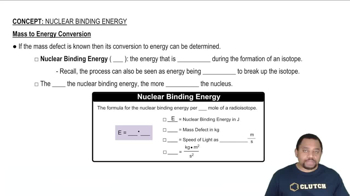
Nuclear Binding Energy

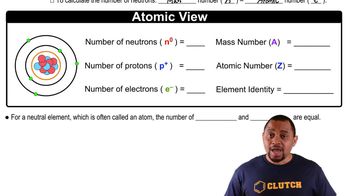
Isotopes

Isotopes are variants of a particular chemical element that have the same number of protons but different numbers of neutrons. In the question, lithium-6 (with 3 protons and 3 neutrons) and deuterium (with 1 proton and 1 neutron) are isotopes that participate in the reaction, highlighting the importance of understanding isotopic composition in nuclear chemistry.
Video consigliato:

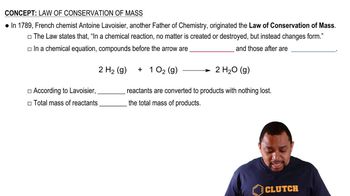
Conservation of Mass and Charge

In nuclear reactions, both mass and charge must be conserved. This principle dictates that the total mass and charge of the reactants must equal the total mass and charge of the products. Identifying the two identical particles formed from the reaction requires applying this conservation law to ensure that the resulting particles maintain the balance of mass and charge from the original nuclides.
Video consigliato:
Percorso guidato
01:48
Law of Conservation of Mass