Ch.20 - Radioactivity and Nuclear Chemistry
Tro - Chemistry: A Molecular Approach 4th Edition
Tro4th EditionChemistry: A Molecular ApproachISBN: 9780134112831Non è quello che usi tu?Cambia libro di testo
Capitolo 20, Problema 44a,b

Which nuclide in each pair would you expect to have the longer half-life? a. Cs-149 or Cs-139 b. Fe-45 or Fe-52

Guida verificata passo dopo passo
1
Identify the nuclides in the pair: Cs-149 and Cs-139.
Understand that the half-life of a nuclide is influenced by its nuclear stability.
Consider the neutron-to-proton ratio for each nuclide, as a more balanced ratio often indicates greater stability.
Research or recall the known half-lives of these isotopes if available, as empirical data can provide direct insight.
Conclude which nuclide is more stable and thus likely to have a longer half-life based on the above analysis.

Risposta video verificata per un problema simile:

Questa soluzione video è stata consigliata dai nostri tutor come utile per risolvere questo problema.
Durata del video:
1m

Concetti chiave

Ecco i concetti essenziali che devi comprendere per rispondere correttamente alla domanda.

Half-Life

Half-life is the time required for half of the radioactive nuclei in a sample to decay. It is a key concept in nuclear chemistry and helps in understanding the stability of isotopes. A longer half-life indicates a more stable nuclide, as it decays more slowly compared to those with shorter half-lives.
Video consigliato:
Percorso guidato
02:17
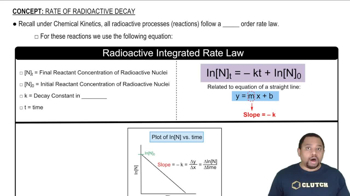
Zero-Order Half-life

Radioactive Decay

Radioactive decay is the process by which an unstable atomic nucleus loses energy by emitting radiation. This can occur in various forms, including alpha, beta, and gamma decay. The type of decay and the energy released can influence the half-life of a nuclide, affecting its stability and longevity.
Video consigliato:
Percorso guidato
03:00
Rate of Radioactive Decay

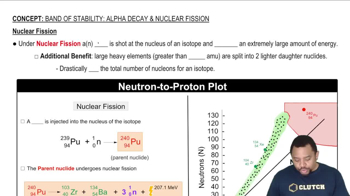
Nuclear Stability

Nuclear stability refers to the tendency of a nucleus to remain intact without undergoing radioactive decay. Factors influencing stability include the ratio of neutrons to protons and the overall binding energy of the nucleus. Generally, isotopes with a balanced neutron-to-proton ratio are more stable and exhibit longer half-lives.
Video consigliato:
Percorso guidato
03:29
Band of Stability: Nuclear Fission