Ch.20 - Radioactivity and Nuclear Chemistry
Tro - Chemistry: A Molecular Approach 4th Edition
Tro4th EditionChemistry: A Molecular ApproachISBN: 9780134112831Non è quello che usi tu?Cambia libro di testo
Capitolo 20, Problema 34

Write a partial decay series for Rn-220 undergoing the sequential decays: a, a, b, b.

Guida verificata passo dopo passo
1
Identify the initial isotope: Rn-220 (Radon-220).
Understand the decay process: Alpha (α) decay reduces the atomic number by 2 and the mass number by 4.
Apply the first α decay: Rn-220 undergoes α decay to form a new element with atomic number 84 and mass number 216.
Apply the second α decay: The new element undergoes another α decay, reducing the atomic number by 2 and the mass number by 4 again.
Apply the first β decay: Beta (β) decay increases the atomic number by 1 while the mass number remains unchanged.

Risposta video verificata per un problema simile:

Questa soluzione video è stata consigliata dai nostri tutor come utile per risolvere questo problema.
Durata del video:
3m

Concetti chiave

Ecco i concetti essenziali che devi comprendere per rispondere correttamente alla domanda.

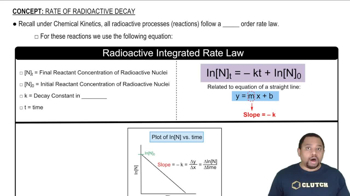
Radioactive Decay

Radioactive decay is the process by which unstable atomic nuclei lose energy by emitting radiation. This can occur in various forms, including alpha (α) decay, where a helium nucleus is emitted, and beta (β) decay, where a neutron is transformed into a proton, emitting an electron. Understanding these decay processes is essential for predicting the transformation of one element into another over time.
Video consigliato:
Percorso guidato
03:00
Rate of Radioactive Decay

Decay Series

A decay series is a sequence of radioactive decays that an unstable nucleus undergoes until it reaches a stable state. Each step in the series involves the emission of radiation and results in the formation of a new element or isotope. In the case of Rn-220, the decay series will illustrate how it transforms through multiple decay events, leading to different daughter isotopes.
Video consigliato:
Percorso guidato
02:02
Activity Series Chart

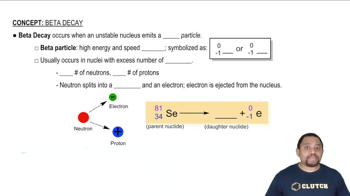
Alpha and Beta Decay

Alpha decay involves the emission of an alpha particle (two protons and two neutrons), resulting in a decrease of the atomic number by two and the mass number by four. Beta decay, on the other hand, involves the conversion of a neutron into a proton with the emission of a beta particle (an electron), increasing the atomic number by one while the mass number remains unchanged. These processes are fundamental in constructing the decay series for Rn-220.
Video consigliato: