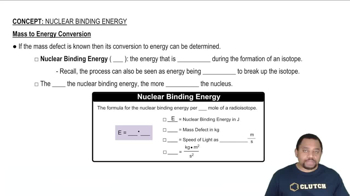
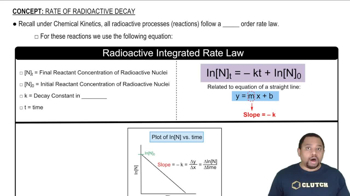
Write the nuclear equation for the most likely mode of decay for each unstable nuclide. a. Kr-74 b. Th-221 c. Ar-44 d. Nb-85
Guida verificata passo dopo passo
1
Step 1: Identify the type of decay for each nuclide based on its atomic number and mass number. Generally, nuclides with a high neutron-to-proton ratio undergo beta decay, while those with a low neutron-to-proton ratio may undergo positron emission or electron capture.
Step 2: For Kr-74, determine the neutron-to-proton ratio. Krypton (Kr) has an atomic number of 36. Calculate the neutron number: 74 - 36 = 38 neutrons. Since Kr-74 is neutron-rich, it is likely to undergo beta decay, where a neutron is converted into a proton, emitting a beta particle (electron) and an antineutrino.
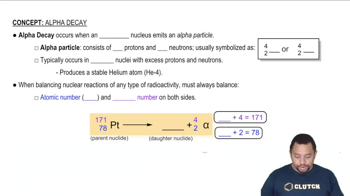
Step 3: For Th-221, thorium (Th) has an atomic number of 90. Calculate the neutron number: 221 - 90 = 131 neutrons. Thorium is a heavy element and typically undergoes alpha decay, where it emits an alpha particle (consisting of 2 protons and 2 neutrons), reducing its atomic number by 2 and mass number by 4.
Step 4: For Ar-44, argon (Ar) has an atomic number of 18. Calculate the neutron number: 44 - 18 = 26 neutrons. Ar-44 is neutron-deficient, suggesting positron emission or electron capture. In positron emission, a proton is converted into a neutron, emitting a positron and a neutrino.
Step 5: For Nb-85, niobium (Nb) has an atomic number of 41. Calculate the neutron number: 85 - 41 = 44 neutrons. Nb-85 is neutron-rich, indicating beta decay as the likely mode of decay, where a neutron is converted into a proton, emitting a beta particle and an antineutrino.
Risposta video verificata per un problema simile:
Questa soluzione video è stata consigliata dai nostri tutor come utile per risolvere questo problema.
Durata del video:
1m
Guarda un video:
0 Commenti
Concetti chiave
Ecco i concetti essenziali che devi comprendere per rispondere correttamente alla domanda.
Nuclear Decay
Nuclear decay is the process by which an unstable atomic nucleus loses energy by emitting radiation. This can occur through various modes, including alpha decay, beta decay, and gamma decay. Each mode involves the transformation of the nucleus, resulting in the emission of particles or electromagnetic radiation, leading to the formation of a different nuclide.
Nuclear equations represent the transformation of one nuclide into another during radioactive decay. They are written to show the initial nuclide, the emitted particles, and the resulting nuclide. For example, in alpha decay, the equation includes the original nuclide, an alpha particle (helium nucleus), and the new nuclide formed after the decay.
Different unstable nuclides undergo specific types of radioactive decay based on their nuclear structure. Alpha decay involves the emission of helium nuclei, beta decay involves the conversion of a neutron into a proton (or vice versa), and positron emission or electron capture can also occur. Understanding the characteristics of each nuclide helps predict the most likely decay mode.


 Guida verificata passo dopo passo
 03:53
03:53