Ch.21 - Organic Chemistry
Tro - Chemistry: A Molecular Approach 4th Edition
Tro4th EditionChemistry: A Molecular ApproachISBN: 9780134112831Non è quello che usi tu?Cambia libro di testo
Capitolo 21, Problema 78

Determine the product of the addition reaction.
Chemical structure showing an addition reaction of an aldehyde with HCN to form a product.

Guida verificata passo dopo passo
1
Identify the functional groups involved in the reaction. Here, we have an aldehyde group (C=O) and hydrogen cyanide (HCN).
Understand the mechanism of the addition reaction. HCN will add across the carbon-oxygen double bond of the aldehyde.
The carbon in the aldehyde group is electrophilic, and the cyanide ion (CN-) from HCN is nucleophilic. The nucleophilic CN- will attack the electrophilic carbon of the carbonyl group.
This attack will result in the formation of a tetrahedral intermediate where the carbonyl carbon now has an additional bond to the CN group and an OH group (from the protonation of the oxygen).
The final product will be a cyanohydrin, where the original carbonyl carbon is now bonded to an OH group and a CN group.

Risposta video verificata per un problema simile:

Questa soluzione video è stata consigliata dai nostri tutor come utile per risolvere questo problema.
Durata del video:
1m

Concetti chiave

Ecco i concetti essenziali che devi comprendere per rispondere correttamente alla domanda.

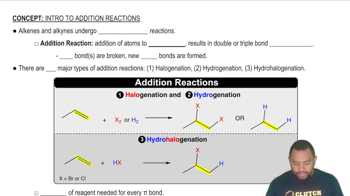
Addition Reactions

Addition reactions involve the combination of two or more reactants to form a single product. In organic chemistry, these reactions often occur with unsaturated compounds, such as alkenes and alkynes, where π bonds are broken to allow new σ bonds to form. The reaction typically results in the saturation of the molecule, increasing the number of single bonds.
Video consigliato:
Percorso guidato
02:55
Addition Reactions

Aldehydes and Their Reactivity

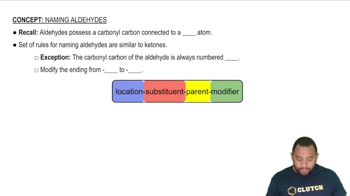
Aldehydes are organic compounds characterized by the presence of a carbonyl group (C=O) at the end of a carbon chain. They are highly reactive due to the electrophilic nature of the carbonyl carbon, making them susceptible to nucleophilic attack. In the presence of nucleophiles, such as HCN, aldehydes can undergo addition reactions to form new products, often resulting in the formation of cyanohydrins.
Video consigliato:
Percorso guidato
00:54
Rules for Naming Aldehydes

Nucleophilic Addition

Nucleophilic addition is a fundamental reaction mechanism in organic chemistry where a nucleophile attacks an electrophilic center, typically a carbon atom in a carbonyl group. This process leads to the formation of a new bond and often results in the conversion of a carbonyl compound into an alcohol or other functional groups. In the case of the reaction with HCN, the cyanide ion acts as the nucleophile, adding to the carbonyl carbon of the aldehyde.
Video consigliato:
Percorso guidato
02:55
Addition Reactions