Ch.21 - Organic Chemistry
Tro - Chemistry: A Molecular Approach 4th Edition
Tro4th EditionChemistry: A Molecular ApproachISBN: 9780134112831Non è quello che usi tu?Cambia libro di testo
Capitolo 21, Problema 38c

Determine whether each compound exhibits optical isomerism c.

Guida verificata passo dopo passo
1
Identify the presence of a chiral center in the compound. A chiral center is typically a carbon atom bonded to four different groups.
Check if the compound is symmetrical. Optical isomerism occurs in compounds that are not superimposable on their mirror images, which means they lack an internal plane of symmetry.
Consider the molecular geometry. For a compound to exhibit optical isomerism, it must have a non-planar structure that allows for the existence of enantiomers.
Determine if the compound can exist as a pair of enantiomers. Enantiomers are non-superimposable mirror images of each other, and their presence indicates optical isomerism.
Review the compound's stereochemistry. If the compound has stereocenters and can exist in multiple stereoisomeric forms, it may exhibit optical isomerism.

Risposta video verificata per un problema simile:

Questa soluzione video è stata consigliata dai nostri tutor come utile per risolvere questo problema.
Durata del video:
1m

Concetti chiave

Ecco i concetti essenziali che devi comprendere per rispondere correttamente alla domanda.

Optical Isomerism

Optical isomerism, also known as chirality, occurs when a molecule can exist in two non-superimposable mirror image forms called enantiomers. These isomers have identical physical properties except for the direction in which they rotate plane-polarized light. The presence of a chiral center, typically a carbon atom bonded to four different substituents, is a key factor in determining whether a compound exhibits optical isomerism.
Video consigliato:
Percorso guidato
2:14
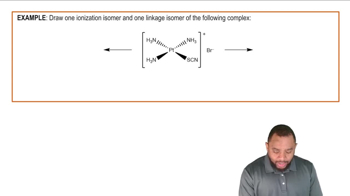
Isomerism in Coordination Complexes Example

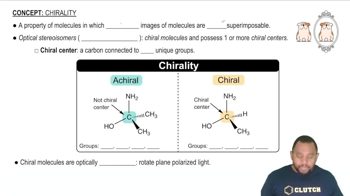
Chiral Centers

A chiral center, often a carbon atom, is a point in a molecule where four different groups are attached, leading to the possibility of forming two distinct stereoisomers. The arrangement of these groups around the chiral center determines the molecule's chirality. Identifying chiral centers is essential for assessing whether a compound can exhibit optical isomerism.
Video consigliato:

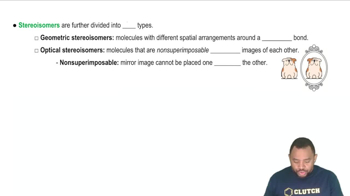
Stereoisomerism

Stereoisomerism refers to the phenomenon where compounds have the same molecular formula and connectivity of atoms but differ in the spatial arrangement of their atoms. This category includes optical isomers, which are specifically related to the orientation of substituents around chiral centers. Understanding stereoisomerism is crucial for determining the optical activity of compounds and their potential isomeric forms.
Video consigliato: