Ch.21 - Organic Chemistry
Tro - Chemistry: A Molecular Approach 4th Edition
Tro4th EditionChemistry: A Molecular ApproachISBN: 9780134112831Non è quello che usi tu?Cambia libro di testo
Capitolo 21, Problema 44

Draw a structure for each alkane. a. 2,2-dimethylpentane b. 3-isopropylheptane Draw a structure for each alkane. d. 4,4-diethyloctane

Guida verificata passo dopo passo
1
Identify the parent chain for each alkane. For 2,2-dimethylpentane, the parent chain is pentane, which has 5 carbon atoms. For 3-isopropylheptane, the parent chain is heptane, which has 7 carbon atoms. For 4,4-diethyloctane, the parent chain is octane, which has 8 carbon atoms.
Determine the substituents and their positions on the parent chain. For 2,2-dimethylpentane, there are two methyl groups attached to the second carbon. For 3-isopropylheptane, there is an isopropyl group attached to the third carbon. For 4,4-diethyloctane, there are two ethyl groups attached to the fourth carbon.
Draw the carbon skeleton of the parent chain. For pentane, draw a straight chain of 5 carbon atoms. For heptane, draw a straight chain of 7 carbon atoms. For octane, draw a straight chain of 8 carbon atoms.
Add the substituents to the appropriate carbon atoms on the parent chain. For 2,2-dimethylpentane, add a methyl group to the second carbon from both ends. For 3-isopropylheptane, add an isopropyl group to the third carbon. For 4,4-diethyloctane, add an ethyl group to the fourth carbon from both ends.
Ensure that each carbon atom forms four bonds, completing the structure by adding hydrogen atoms where necessary.

Risposta video verificata per un problema simile:

Questa soluzione video è stata consigliata dai nostri tutor come utile per risolvere questo problema.
Durata del video:
2m

Concetti chiave

Ecco i concetti essenziali che devi comprendere per rispondere correttamente alla domanda.

Alkane Structure

Alkanes are hydrocarbons that consist solely of carbon (C) and hydrogen (H) atoms, connected by single bonds. Their general formula is CnH2n+2, where 'n' is the number of carbon atoms. The structure of alkanes can be represented in various forms, including condensed structural formulas and skeletal structures, which illustrate the connectivity of atoms.
Video consigliato:
Percorso guidato
01:20
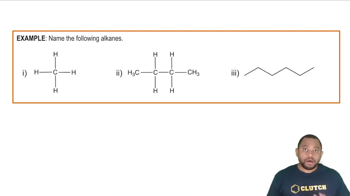
Naming Alkanes Example

Isomerism in Alkanes

Isomerism occurs when compounds have the same molecular formula but different structural arrangements. In alkanes, this can lead to different physical and chemical properties. For example, 2,2-dimethylpentane and 3-isopropylheptane are structural isomers, meaning they have the same number of carbon and hydrogen atoms but differ in how these atoms are arranged.
Video consigliato:
Percorso guidato
01:20
Naming Alkanes Example

Naming Alkanes (IUPAC Nomenclature)

The International Union of Pure and Applied Chemistry (IUPAC) provides a systematic way to name organic compounds, including alkanes. The name reflects the longest carbon chain and the position of any substituents. For instance, in 4,4-diethyloctane, 'octane' indicates an eight-carbon chain, while '4,4-diethyl' specifies that two ethyl groups are attached to the fourth carbon of the chain.
Video consigliato:
Percorso guidato
02:39
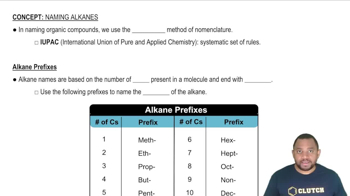
Rules for Naming Alkanes