Ch.21 - Organic Chemistry
Tro - Chemistry: A Molecular Approach 4th Edition
Tro4th EditionChemistry: A Molecular ApproachISBN: 9780134112831Non è quello che usi tu?Cambia libro di testo
Capitolo 21, Problema 75b

Name each aldehyde or ketone. b.

Guida verificata passo dopo passo
1
Identify the functional group present in the compound. Aldehydes have the carbonyl group (C=O) at the end of the carbon chain, while ketones have it within the carbon chain.
Determine the longest carbon chain that contains the carbonyl group. This will help in identifying the base name of the compound.
For aldehydes, replace the '-e' ending of the corresponding alkane with '-al'. For ketones, replace the '-e' ending with '-one'.
Number the carbon chain starting from the end nearest to the carbonyl group. This helps in assigning the lowest possible number to the carbonyl carbon.
If there are substituents, name and number them according to their position on the carbon chain, and list them in alphabetical order before the base name.

Risposta video verificata per un problema simile:

Questa soluzione video è stata consigliata dai nostri tutor come utile per risolvere questo problema.
Durata del video:
2m

Concetti chiave

Ecco i concetti essenziali che devi comprendere per rispondere correttamente alla domanda.

Aldehydes

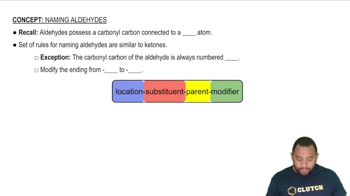
Aldehydes are organic compounds characterized by the presence of a carbonyl group (C=O) at the end of a carbon chain. The general formula for aldehydes is RCHO, where R represents a hydrocarbon group. Common examples include formaldehyde and acetaldehyde. Aldehydes are known for their distinctive odors and are often used in the production of various chemicals and as preservatives.
Video consigliato:
Percorso guidato
00:54
Rules for Naming Aldehydes

Ketones

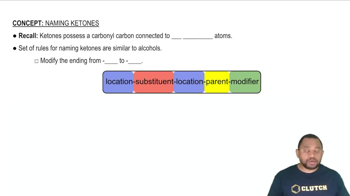
Ketones are organic compounds that contain a carbonyl group (C=O) located within a carbon chain, specifically between two carbon atoms. The general formula for ketones is RC(=O)R', where R and R' can be the same or different hydrocarbon groups. Acetone is a well-known example of a ketone, commonly used as a solvent. Ketones are important in various chemical reactions and industrial applications.
Video consigliato:
Percorso guidato
00:39
Rules for Naming Ketones

Nomenclature of Organic Compounds

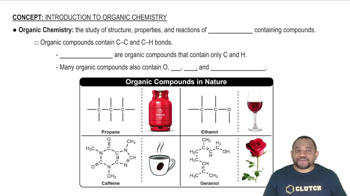
The nomenclature of organic compounds follows specific rules set by the International Union of Pure and Applied Chemistry (IUPAC). For aldehydes, the suffix '-al' is used, while for ketones, the suffix '-one' is applied. The naming process involves identifying the longest carbon chain containing the functional group, numbering the chain to give the functional group the lowest possible number, and then applying the appropriate suffix based on the compound type.
Video consigliato:
Percorso guidato
02:26
Introduction to Organic Chemistry