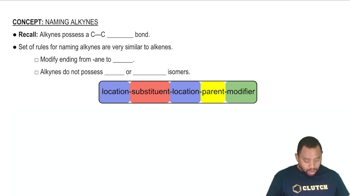
Identify the longest carbon chain that includes the triple bond. This will determine the base name of the alkyne.
Number the carbon chain starting from the end nearest to the triple bond to give the lowest possible number to the triple bond.
Identify and name any substituents attached to the carbon chain.
Combine the names of the substituents with the base name of the alkyne, placing the substituents in alphabetical order and using numbers to indicate their positions.
Ensure the name follows IUPAC nomenclature rules, using the suffix '-yne' to indicate the presence of a triple bond.
Risposta video verificata per un problema simile:
Questa soluzione video è stata consigliata dai nostri tutor come utile per risolvere questo problema.
Durata del video:
3m
Guarda un video:
0 Commenti
Concetti chiave
Ecco i concetti essenziali che devi comprendere per rispondere correttamente alla domanda.
Alkynes
Alkynes are a class of hydrocarbons characterized by at least one carbon-carbon triple bond (C≡C). They follow the general formula CnH2n-2, where 'n' is the number of carbon atoms. Alkynes are unsaturated compounds, meaning they contain fewer hydrogen atoms than alkanes and alkenes, which can affect their reactivity and properties.
The nomenclature of alkynes follows the IUPAC naming conventions, where the longest carbon chain containing the triple bond is identified. The name is derived from the base name of the alkane with the same number of carbons, with the suffix '-yne' indicating the presence of a triple bond. Additionally, the position of the triple bond is indicated by a number, which corresponds to the first carbon of the triple bond in the chain.
Alkynes can exhibit structural isomerism, where compounds with the same molecular formula have different arrangements of atoms. This includes chain isomerism, where the carbon skeleton differs, and position isomerism, where the location of the triple bond varies. Understanding isomerism is crucial for naming and distinguishing between different alkyne compounds.