Ch.21 - Organic Chemistry
Tro - Chemistry: A Molecular Approach 4th Edition
Tro4th EditionChemistry: A Molecular ApproachISBN: 9780134112831Non è quello che usi tu?Cambia libro di testo
Capitolo 21, Problema 91b

Name each compound. b.

Guida verificata passo dopo passo
1
Identify the type of compound: Determine if the compound is ionic, covalent (molecular), or an acid, as this will guide the naming process.
For ionic compounds: Name the cation (positive ion) first, followed by the anion (negative ion). If the cation is a transition metal, indicate its charge with Roman numerals in parentheses.
For covalent (molecular) compounds: Use prefixes to indicate the number of each type of atom present (e.g., mono-, di-, tri-), and name the elements in the order they appear, changing the ending of the second element to '-ide'.
For acids: If the compound is a binary acid (composed of hydrogen and one other element), use the prefix 'hydro-' followed by the root of the element name and the suffix '-ic acid'. For oxyacids (acids containing oxygen), use the root of the polyatomic ion name, changing '-ate' to '-ic acid' or '-ite' to '-ous acid'.
Apply the appropriate naming rules to the given compound, ensuring that all elements and their quantities are correctly represented in the name.

Risposta video verificata per un problema simile:

Questa soluzione video è stata consigliata dai nostri tutor come utile per risolvere questo problema.
Durata del video:
2m

Concetti chiave

Ecco i concetti essenziali che devi comprendere per rispondere correttamente alla domanda.

Nomenclature

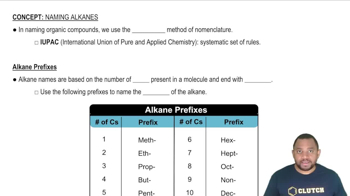
Nomenclature in chemistry refers to the systematic naming of chemical compounds based on established rules. The International Union of Pure and Applied Chemistry (IUPAC) provides guidelines for naming organic and inorganic compounds, ensuring that each name conveys specific information about the compound's structure and composition.
Video consigliato:
Percorso guidato
02:39
Rules for Naming Alkanes

Chemical Formula

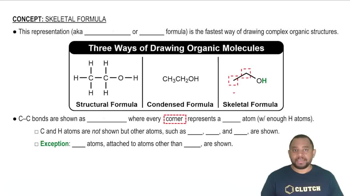
A chemical formula represents the elements in a compound and their respective quantities. It provides a concise way to convey the composition of a substance, such as H2O for water, indicating two hydrogen atoms and one oxygen atom. Understanding chemical formulas is essential for correctly identifying and naming compounds.
Video consigliato:
Percorso guidato
02:26
Skeletal Formula

Functional Groups

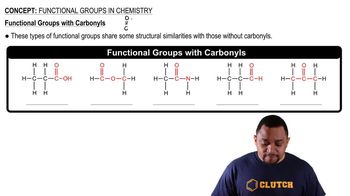
Functional groups are specific groups of atoms within molecules that are responsible for the characteristic chemical reactions of those molecules. Recognizing functional groups, such as hydroxyl (-OH) or carboxyl (-COOH), is crucial for naming organic compounds and predicting their reactivity and properties.
Video consigliato:
Percorso guidato
01:32
Carbonyl Functional Groups