Ch.21 - Organic Chemistry
Tro - Chemistry: A Molecular Approach 4th Edition
Tro4th EditionChemistry: A Molecular ApproachISBN: 9780134112831Non è quello che usi tu?Cambia libro di testo
Capitolo 21, Problema 66b

Name each disubstituted benzene. b.
Chemical structure of a disubstituted benzene with two chlorine atoms.

Guida verificata passo dopo passo
1
Identify the parent structure, which is benzene.
Determine the substituents attached to the benzene ring. In this case, there are two chlorine (Cl) atoms.
Number the carbon atoms in the benzene ring such that the substituents get the lowest possible numbers. Start numbering from one of the carbons with a chlorine atom.
Assign the positions of the chlorine atoms. For example, if the chlorines are on adjacent carbons, they are in the 1,2-positions.
Combine the position numbers with the substituent names and the parent structure to form the name. For instance, if the chlorines are in the 1,2-positions, the name would be 1,2-dichlorobenzene.

Risposta video verificata per un problema simile:

Questa soluzione video è stata consigliata dai nostri tutor come utile per risolvere questo problema.
Durata del video:
1m

Concetti chiave

Ecco i concetti essenziali che devi comprendere per rispondere correttamente alla domanda.

Disubstituted Benzene

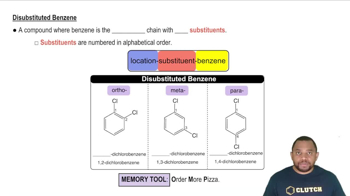
Disubstituted benzene refers to a benzene ring that has two substituents attached to it. The position of these substituents can significantly affect the chemical properties and reactivity of the compound. The naming of disubstituted benzenes follows specific rules based on the relative positions of the substituents, which can be ortho (adjacent), meta (one carbon apart), or para (opposite sides).
Video consigliato:
Percorso guidato
02:16
Disubstituted Benzene

Nomenclature of Aromatic Compounds

The nomenclature of aromatic compounds, particularly disubstituted benzenes, is governed by the IUPAC naming conventions. The substituents are named in alphabetical order, and the positions are indicated by numbers based on the carbon atoms of the benzene ring. For example, in the case of two chlorine substituents, the compound can be named as 1,2-dichlorobenzene (ortho), 1,3-dichlorobenzene (meta), or 1,4-dichlorobenzene (para) depending on their positions.
Video consigliato:
Percorso guidato
02:11
Ionic Compounds Naming

Electrophilic Aromatic Substitution

Electrophilic aromatic substitution is a fundamental reaction mechanism in organic chemistry where an electrophile replaces a hydrogen atom on an aromatic ring. This process is crucial for understanding how substituents can influence the reactivity of the benzene ring. The presence of electron-withdrawing groups, like chlorine, can direct incoming electrophiles to specific positions on the ring, affecting the overall structure and properties of the resulting disubstituted benzene.
Video consigliato:
Percorso guidato
01:08
Alcohol Reactions: Substitution Reactions