Ch.3 - Molecules, Compounds & Chemical Equations
Tro - Chemistry: A Molecular Approach 4th Edition
Tro4th EditionChemistry: A Molecular ApproachISBN: 9780134112831Non è quello che usi tu?Cambia libro di testo
Capitolo 3, Problema 31a

Based on the molecular views, classify each substance as an atomic element, a molecular element, an ionic compound, or a molecular compound.

Guida verificata passo dopo passo
1
Identify the type of particles present in each substance. Atomic elements consist of single atoms, molecular elements consist of molecules made of the same type of atom, ionic compounds consist of cations and anions, and molecular compounds consist of molecules made of different types of atoms.
For each substance, determine if it is composed of individual atoms, molecules of the same element, molecules of different elements, or ions.
If the substance is composed of individual atoms of a single element, classify it as an atomic element.
If the substance is composed of molecules made of the same type of atom, classify it as a molecular element.
If the substance is composed of ions, classify it as an ionic compound. If it is composed of molecules made of different types of atoms, classify it as a molecular compound.

Risposta video verificata per un problema simile:

Questa soluzione video è stata consigliata dai nostri tutor come utile per risolvere questo problema.
Durata del video:
4m

Concetti chiave

Ecco i concetti essenziali che devi comprendere per rispondere correttamente alla domanda.

Atomic Elements

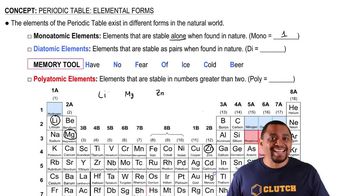
Atomic elements consist of single atoms that are not bonded to other atoms. These elements are found in their pure form on the periodic table, such as helium (He) or gold (Au). They represent the simplest form of matter and cannot be broken down into simpler substances by chemical means.
Video consigliato:
Percorso guidato
02:35
Elemental Forms of Elements

Molecular Elements

Molecular elements are composed of two or more atoms of the same element that are chemically bonded together. A common example is diatomic molecules like oxygen (O2) and nitrogen (N2). These substances exist as discrete molecules rather than individual atoms, which influences their physical and chemical properties.
Video consigliato:
Percorso guidato
02:35
Elemental Forms of Elements

Ionic and Molecular Compounds

Ionic compounds are formed from the electrostatic attraction between positively and negatively charged ions, typically between metals and nonmetals, such as sodium chloride (NaCl). In contrast, molecular compounds consist of molecules formed by covalent bonds between nonmetals, like water (H2O). Understanding the differences in bonding and structure is crucial for classifying substances correctly.
Video consigliato:
Percorso guidato
02:11
Ionic Compounds Naming