Ch.3 - Molecules, Compounds & Chemical Equations
Tro - Chemistry: A Molecular Approach 4th Edition
Tro4th EditionChemistry: A Molecular ApproachISBN: 9780134112831Non è quello che usi tu?Cambia libro di testo
Capitolo 3, Problema 106

Write the balanced equation for the photosynthesis reaction in which gaseous carbon dioxide and liquid water react in the presence of chlorophyll to produce aqueous glucose (C6H12O6) and oxygen gas.

Guida verificata passo dopo passo
1
Write the unbalanced chemical equation for the photosynthesis reaction: \( \text{CO}_2 (g) + \text{H}_2\text{O} (l) \rightarrow \text{C}_6\text{H}_{12}\text{O}_6 (aq) + \text{O}_2 (g) \)
Balance the carbon atoms: Since there are 6 carbon atoms in glucose (\(\text{C}_6\text{H}_{12}\text{O}_6\)), you need 6 \(\text{CO}_2\) molecules.
Balance the hydrogen atoms: Glucose has 12 hydrogen atoms, so you need 6 \(\text{H}_2\text{O}\) molecules to provide these hydrogen atoms.
Balance the oxygen atoms: Count the total oxygen atoms on both sides and adjust the \(\text{O}_2\) molecules to balance them.
Verify that all elements are balanced: Ensure that the number of atoms for each element is the same on both sides of the equation.

Concetti chiave

Ecco i concetti essenziali che devi comprendere per rispondere correttamente alla domanda.

Photosynthesis

Photosynthesis is the biochemical process by which green plants, algae, and some bacteria convert light energy into chemical energy. This process primarily occurs in the chloroplasts of plant cells, where chlorophyll captures sunlight to drive the conversion of carbon dioxide and water into glucose and oxygen. The overall reaction is essential for producing the organic compounds that serve as food for the plant and, indirectly, for other organisms.
Video consigliato:
Percorso guidato
03:05
Spontaneity of Processes Example

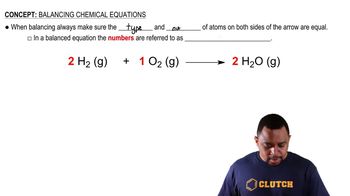
Chemical Equation Balancing

Balancing a chemical equation involves ensuring that the number of atoms for each element is the same on both the reactant and product sides. This is based on the law of conservation of mass, which states that matter cannot be created or destroyed in a chemical reaction. Balancing is crucial for accurately representing the stoichiometry of the reaction, which indicates the proportions of reactants and products involved.
Video consigliato:
Percorso guidato
01:32
Balancing Chemical Equations

Reactants and Products

In a chemical reaction, reactants are the starting substances that undergo a transformation, while products are the substances formed as a result of the reaction. In the context of photosynthesis, the reactants are carbon dioxide (CO2) and water (H2O), and the products are glucose (C6H12O6) and oxygen (O2). Understanding the roles of reactants and products is fundamental to writing and interpreting chemical equations.
Video consigliato:
Percorso guidato
00:53
Production of Hydrogen Example