
Domanda del libro di testo
Calculate how many moles of NO2 form when each quantity of reactant completely reacts. 2 N2O5( g) → 4 NO2(g) + O2(g) a. 2.5 mol N2O5
6124
views

 Guida verificata passo dopo passo
 01:16
01:16
 01:32
01:32 01:25
01:25Calculate how many moles of NO2 form when each quantity of reactant completely reacts. 2 N2O5( g) → 4 NO2(g) + O2(g) a. 2.5 mol N2O5
Hydrobromic acid dissolves solid iron according to the reaction:
Fe(s) + 2 HBr(aq) → FeBr2(aq) + H2(g)
What mass of HBr (in g) do you need to dissolve a 3.2-g pure iron bar on a padlock?
Hydrobromic acid dissolves solid iron according to the reaction:
Fe(s) + 2 HBr(aq) → FeBr2(aq) + H2(g)
What mass of HBr (in g) do you need to dissolve a 3.2-g pure iron bar on a padlock? What mass of H2 would the complete reaction of the iron bar produce?
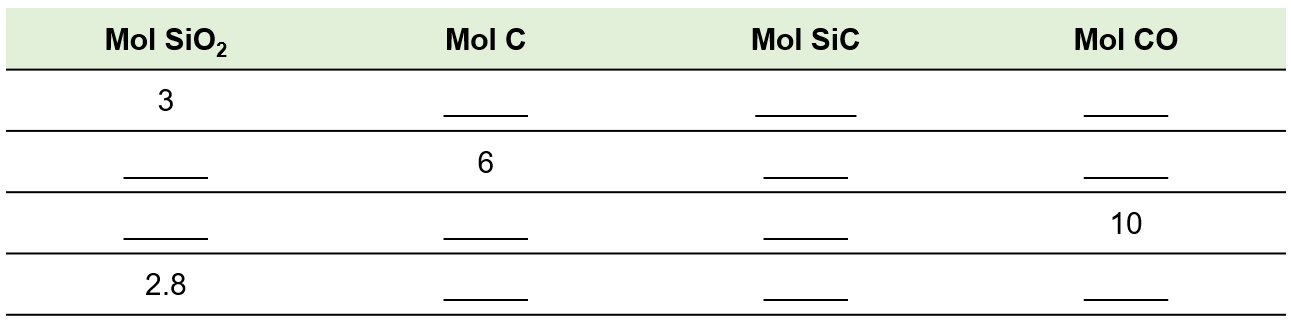
Consider the balanced equation:
SiO2(s) + 3 C(s) → SiC(s) + 2 CO(g)
Complete the table showing the appropriate number of moles of reactants and products. If the number of moles of a reactant is provided, fill in the required amount of the other reactant, as well as the moles of each product that forms. If the number of moles of a product is provided, fill in the required amount of each reactant to make that amount of product, as well as the amount of the other product that forms.
Calculate how many moles of NH3 form when each quantity of reactant completely reacts. 3 N2H4(l) → 4 NH3(g) + N2(g) c. 65.3 g N2H4