
Ch.4 - Chemical Quantities & Aqueous Reactions
Tro - Chemistry: A Molecular Approach 4th Edition
Tro4th EditionChemistry: A Molecular ApproachISBN: 9780134112831Non è quello che usi tu?Cambia libro di testo
Capitolo 4, Problema 118

Find the volume of 0.110 M hydrochloric acid necessary to react completely with 1.52 g Al(OH)3.

Guida verificata passo dopo passo
1
Identify the balanced chemical equation for the reaction: \[ \text{Al(OH)}_3 + 3\text{HCl} \rightarrow \text{AlCl}_3 + 3\text{H}_2\text{O} \]
Calculate the moles of \( \text{Al(OH)}_3 \) using its molar mass: \[ \text{Moles of Al(OH)}_3 = \frac{1.52 \text{ g}}{\text{Molar mass of Al(OH)}_3} \]
Use the stoichiometry of the balanced equation to find the moles of \( \text{HCl} \) needed: \[ \text{Moles of HCl} = 3 \times \text{Moles of Al(OH)}_3 \]
Calculate the volume of \( 0.110 \text{ M} \) \( \text{HCl} \) solution required using the formula: \[ \text{Volume (L)} = \frac{\text{Moles of HCl}}{0.110 \text{ M}} \]
Convert the volume from liters to milliliters if necessary: \[ \text{Volume (mL)} = \text{Volume (L)} \times 1000 \]

Risposta video verificata per un problema simile:

Questa soluzione video è stata consigliata dai nostri tutor come utile per risolvere questo problema.
Durata del video:
2m

Concetti chiave

Ecco i concetti essenziali che devi comprendere per rispondere correttamente alla domanda.

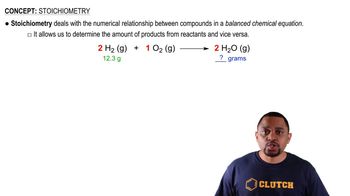
Stoichiometry

Stoichiometry is the calculation of reactants and products in chemical reactions. It involves using balanced chemical equations to determine the relationships between the amounts of substances consumed and produced. In this case, stoichiometry will help us find the moles of hydrochloric acid needed to react with aluminum hydroxide.
Video consigliato:
Percorso guidato
01:16
Stoichiometry Concept

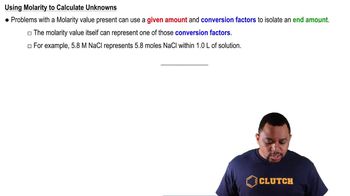
Molarity

Molarity (M) is a measure of concentration defined as the number of moles of solute per liter of solution. It is crucial for determining how much of a solution is needed to achieve a desired reaction. In this question, the molarity of hydrochloric acid will be used to calculate the volume required for the reaction with aluminum hydroxide.
Video consigliato:

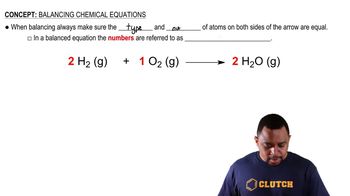
Balanced Chemical Equation

A balanced chemical equation represents a chemical reaction with equal numbers of each type of atom on both sides of the equation. It provides the mole ratios needed for stoichiometric calculations. For this problem, the balanced equation between hydrochloric acid and aluminum hydroxide will indicate how many moles of HCl are required to completely react with the given mass of Al(OH)3.
Video consigliato:
Percorso guidato
01:32
Balancing Chemical Equations
Pratica correlata
Domanda del libro di testo

The nitrogen in sodium nitrate and in ammonium sulfate is available to plants as fertilizer. Which is the more economical source of nitrogen, a fertilizer containing 30.0% sodium nitrate by weight and costing \$9.00 per 100 lb or one containing 20.0% ammonium sulfate by weight and costing \$8.10 per 100 lb?

1338
views
Domanda del libro di testo

Treatment of gold metal with BrF3 and KF produces Br2 and KAuF4, a salt of gold. Identify the oxidizing agent and the reducing agent in this reaction.

906
views
Domanda del libro di testo

A solution contains Cr3+ ions and Mg2+ ions. The addition of 1.00 L of 1.51 M NaF solution causes the complete precipitation of these ions as CrF3(s) and MgF2(s). The total mass of the precipitate is 49.6 g. Find the mass of Cr3+ in the original solution.

2318
views
Domanda del libro di testo

Find the mass of barium metal (in grams) that must react with O2 to produce enough barium oxide to prepare 1.0 L of a 0.10 M solution of OH-.

1366
views
Domanda del libro di testo

Treatment of gold metal with BrF3 and KF produces Br2 and KAuF4, a salt of gold. Find the mass of the gold salt that forms when a 73.5-g mixture of equal masses of all three reactants is prepared.

2630
views
Domanda del libro di testo

A solution contains one or more of the following ions: Ag+ , Ca2+ , and Cu2+ . When you add sodium chloride to the solution, no precipitate forms. When you add sodium sulfate to the solution, a white precipitate forms. You filter off the precipitate and add sodium carbonate to the remaining solution, producing another precipitate. Write net ionic equations for the formation of each of the precipitates observed.

3087
views