Ch.4 - Chemical Quantities & Aqueous Reactions
Tro - Chemistry: A Molecular Approach 4th Edition
Tro4th EditionChemistry: A Molecular ApproachISBN: 9780134112831Non è quello che usi tu?Cambia libro di testo
Capitolo 4, Problema 32

Sulfuric acid dissolves aluminum metal according to the reaction:
2 Al(s) + 3 H2SO4(aq) → Al2(SO4)3(aq) + 3 H2( g)
Suppose you want to dissolve an aluminum block with a mass of 15.2 g. What minimum mass of H2SO4 (in g) do you need? What mass of H2 gas (in g) does the complete reaction of the aluminum block produce?

Guida verificata passo dopo passo
1
Calculate the moles of aluminum (Al) using its molar mass.
Use the stoichiometry of the balanced chemical equation to determine the moles of H2SO4 needed.
Convert the moles of H2SO4 to grams using its molar mass.
Use the stoichiometry of the balanced chemical equation to determine the moles of H2 gas produced.
Convert the moles of H2 gas to grams using its molar mass.

Risposta video verificata per un problema simile:

Questa soluzione video è stata consigliata dai nostri tutor come utile per risolvere questo problema.
Durata del video:
3m

Concetti chiave

Ecco i concetti essenziali che devi comprendere per rispondere correttamente alla domanda.

Stoichiometry

Stoichiometry is the calculation of reactants and products in chemical reactions based on the balanced chemical equation. It allows us to determine the proportions of substances involved in a reaction. In this case, the stoichiometric coefficients from the balanced equation indicate the molar ratios of aluminum to sulfuric acid and hydrogen gas, which are essential for calculating the required mass of sulfuric acid and the mass of hydrogen produced.
Video consigliato:
Percorso guidato
01:16
Stoichiometry Concept

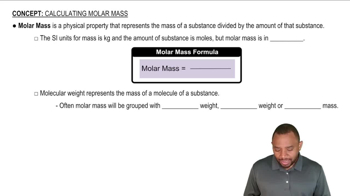
Molar Mass

Molar mass is the mass of one mole of a substance, typically expressed in grams per mole (g/mol). It is crucial for converting between the mass of a substance and the number of moles, which is necessary for stoichiometric calculations. For aluminum (Al) and sulfuric acid (H2SO4), knowing their molar masses allows us to calculate how much sulfuric acid is needed to react with a given mass of aluminum.
Video consigliato:
Percorso guidato
02:11
Molar Mass Concept

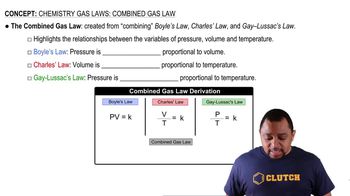
Gas Laws

Gas laws describe the behavior of gases under various conditions of temperature and pressure. In this context, the production of hydrogen gas (H2) from the reaction can be quantified using the ideal gas law if needed. Understanding gas laws helps in predicting the volume or mass of gas produced in a reaction, which is important for determining the amount of hydrogen generated from the complete reaction of aluminum.
Video consigliato:
Percorso guidato
01:43
Combined Gas Law
Pratica correlata
Domanda del libro di testo

For each of the acid–base reactions, calculate the mass (in grams) of each acid necessary to completely react with and neutralize 4.85 g of the base. b. 2 HNO3(aq) + Ca(OH)2(aq) → 2 H2O(l) + Ca(NO3)2(aq)

963
views

Domanda del libro di testo

Hydrobromic acid dissolves solid iron according to the reaction:

Fe(s) + 2 HBr(aq) → FeBr2(aq) + H2(g)

What mass of HBr (in g) do you need to dissolve a 3.2-g pure iron bar on a padlock?

3885
views
Domanda del libro di testo

For each of the reactions, calculate the mass (in grams) of the product that forms when 15.39 g of the underlined reactant completely reacts. Assume that there is more than enough of the other reactant.

a. 2 K(s) + Cl2(g) → 2 KCl(s)

b. 2 K(s) + Br2(l) → 2 KBr(s)

c. 4 Cr(s) + 3 O2(g) → 2 Cr2O3(s)

d. 2 Sr(s) + O2(g) → 2 SrO(s)

3460
views
Domanda del libro di testo

Hydrobromic acid dissolves solid iron according to the reaction:

Fe(s) + 2 HBr(aq) → FeBr2(aq) + H2(g)

What mass of HBr (in g) do you need to dissolve a 3.2-g pure iron bar on a padlock? What mass of H2 would the complete reaction of the iron bar produce?

472
views
Domanda del libro di testo

Consider the balanced equation:

SiO2(s) + 3 C(s) → SiC(s) + 2 CO(g)

Complete the table showing the appropriate number of moles of reactants and products. If the number of moles of a reactant is provided, fill in the required amount of the other reactant, as well as the moles of each product that forms. If the number of moles of a product is provided, fill in the required amount of each reactant to make that amount of product, as well as the amount of the other product that forms.

1100
views