Ch.4 - Chemical Quantities & Aqueous Reactions
Tro - Chemistry: A Molecular Approach 4th Edition
Tro4th EditionChemistry: A Molecular ApproachISBN: 9780134112831Non è quello che usi tu?Cambia libro di testo
Capitolo 4, Problema 104

Toilet bowl cleaners often contain hydrochloric acid, which dissolves the calcium carbonate deposits that accumulate within a toilet bowl. What mass of calcium carbonate (in grams) can be dissolved by 3.8 g of HCl? (Hint: Begin by writing a balanced equation for the reaction between hydrochloric acid and calcium carbonate.)

Guida verificata passo dopo passo
1
Write the balanced chemical equation for the reaction: \( \text{CaCO}_3 (s) + 2\text{HCl} (aq) \rightarrow \text{CaCl}_2 (aq) + \text{CO}_2 (g) + \text{H}_2\text{O} (l) \).
Calculate the molar mass of HCl and CaCO₃ using the periodic table.
Determine the number of moles of HCl present in 3.8 g by using the formula: \( \text{moles of HCl} = \frac{\text{mass of HCl}}{\text{molar mass of HCl}} \).
Use the stoichiometry of the balanced equation to find the moles of CaCO₃ that react with the calculated moles of HCl. Note that 2 moles of HCl react with 1 mole of CaCO₃.
Convert the moles of CaCO₃ to grams using its molar mass: \( \text{mass of CaCO}_3 = \text{moles of CaCO}_3 \times \text{molar mass of CaCO}_3 \).

Concetti chiave

Ecco i concetti essenziali che devi comprendere per rispondere correttamente alla domanda.

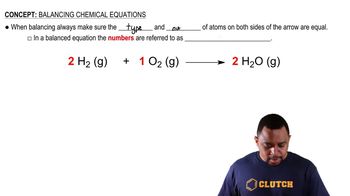
Balanced Chemical Equation

A balanced chemical equation represents a chemical reaction with equal numbers of each type of atom on both sides of the equation. For the reaction between hydrochloric acid (HCl) and calcium carbonate (CaCO3), the balanced equation is: 2 HCl + CaCO3 → CaCl2 + H2O + CO2. This equation is essential for determining the stoichiometric relationships between reactants and products.
Video consigliato:
Percorso guidato
01:32
Balancing Chemical Equations

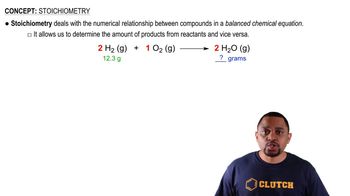
Stoichiometry

Stoichiometry is the calculation of reactants and products in chemical reactions based on the balanced equation. It allows us to determine how much of one substance is needed to react with a given amount of another. In this case, stoichiometry will help us find the mass of calcium carbonate that can be dissolved by a specific mass of hydrochloric acid.
Video consigliato:
Percorso guidato
01:16
Stoichiometry Concept

Molar Mass

Molar mass is the mass of one mole of a substance, typically expressed in grams per mole (g/mol). It is crucial for converting between grams and moles in stoichiometric calculations. For example, the molar mass of calcium carbonate (CaCO3) is approximately 100.09 g/mol, which will be used to calculate how many grams can be dissolved by the available hydrochloric acid.
Video consigliato:
Percorso guidato
02:11
Molar Mass Concept
Pratica correlata
Domanda del libro di testo

The density of a 20.0% by mass ethylene glycol (C2H6O2) solution in water is 1.03 g/mL. Find the molarity of the solution.

3239
views
2
rank

Domanda del libro di testo

Find the percent by mass of sodium chloride in a 1.35 M NaCl solution. The density of the solution is 1.05 g/mL.

2722
views
3
rank
Domanda del libro di testo

The combustion of gasoline produces carbon dioxide and water. Assume gasoline to be pure octane (C8H18) and calculate the mass (in kg) of carbon dioxide that is added to the atmosphere per 1.0 kg of octane burned. (Hint: Begin by writing a balanced equation for the combustion reaction.)

8545
views
Domanda del libro di testo

Many home barbeques are fueled with propane gas (C3H8). What mass of carbon dioxide (in kg) is produced upon the complete combustion of 18.9 L of propane (approximate contents of one 5-gallon tank)? Assume that the density of the liquid propane in the tank is 0.621 g/mL. (Hint: Begin by writing a balanced equation for the combustion reaction.)

1581
views
Domanda del libro di testo

Aspirin can be made in the laboratory by reacting acetic anhydride (C4H6O3) with salicylic acid (C7H6O3) to form aspirin (C9H8O4) and acetic acid (C2H4O2). The balanced equation is: C4H6O3 + C7H6O3 → C9H8O4 + C2H4O2 In a laboratory synthesis, a student begins with 3.00 mL of acetic anhydride (density = 1.08 g/mL) and 1.25 g of salicylic acid. Once the reaction is complete, the student collects 1.22 g of aspirin. Determine the limiting reactant. Determine the theoretical yield of aspirin. Determine the percent yield for the reaction.

17660
views