What is the molarity of ZnCl2 that forms when 25.0 g of zinc completely reacts with CuCl2 according to the following reaction? Assume a final volume of 275 mL. Zn(s) + CuCl2(aq) → ZnCl2(aq) + Cu(s)
Ch.4 - Chemical Quantities & Aqueous Reactions
Tro4th EditionChemistry: A Molecular ApproachISBN: 9780134112831Non è quello che usi tu?Cambia libro di testo
Capitolo 4, Problema 67
What is the minimum amount of 6.0 M H2SO4 necessary to produce 25.0 g of H2(g) according to the reaction between aluminum and sulfuric acid? 2 Al(s) + 3 H2SO4(aq) → Al2(SO4)3(aq) + 3 H2(g)
Guida verificata passo dopo passo1
Determine the molar mass of H_2 by adding the atomic masses of hydrogen atoms.
Calculate the moles of H_2 produced using the formula: moles = mass / molar mass.
Use the stoichiometry of the balanced chemical equation to find the moles of H_2SO_4 needed. According to the equation, 3 moles of H_2SO_4 produce 3 moles of H_2.
Calculate the volume of 6.0 M H_2SO_4 solution required using the formula: volume = moles / molarity.
Ensure the units are consistent and convert the volume to the desired unit if necessary.

Risposta video verificata per un problema simile:
Questa soluzione video è stata consigliata dai nostri tutor come utile per risolvere questo problema.
Concetti chiave
Ecco i concetti essenziali che devi comprendere per rispondere correttamente alla domanda.
Stoichiometry
Stoichiometry is the calculation of reactants and products in chemical reactions based on the balanced chemical equation. It allows us to determine the proportions of substances involved in a reaction, which is essential for converting between grams and moles. In this case, stoichiometry will help us find out how much sulfuric acid is needed to produce a specific mass of hydrogen gas.
Video consigliato:
Percorso guidato
Stoichiometry Concept
Molarity
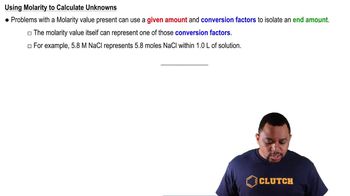
Molarity is a measure of concentration defined as the number of moles of solute per liter of solution. It is crucial for understanding how much of a concentrated solution, like 6.0 M H2SO4, is required to achieve a desired amount of product. By knowing the molarity, we can calculate the volume of sulfuric acid needed to react with aluminum to produce the specified amount of hydrogen gas.
Video consigliato:
Percorso guidato
Molarity
Limiting Reactant
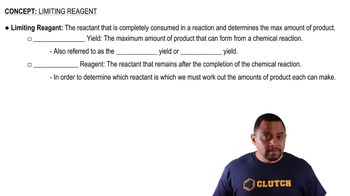
The limiting reactant is the substance that is completely consumed first in a chemical reaction, thus determining the maximum amount of product that can be formed. Identifying the limiting reactant is essential for accurately calculating the quantities of reactants needed. In this scenario, we need to ensure that we have enough sulfuric acid to react with aluminum to produce the desired amount of hydrogen gas.
Video consigliato:
Percorso guidato
Limiting Reagent Concept
Pratica correlata
Domanda del libro di testo
2834
views
1
rank
Domanda del libro di testo
To what volume should you dilute 50.0 mL of a 12 M stock HNO3 solution to obtain a 0.100 M HNO3 solution?
1716
views
Domanda del libro di testo
A 25.0-mL sample of a 1.20 M potassium chloride solution is mixed with 15.0 mL of a 0.900 M lead(II) nitrate solution and this precipitation reaction occurs: 2 KCl(aq) + Pb(NO3)2(aq) → PbCl2(s) + 2 KNO3(aq) The solid PbCl2 is collected, dried, and found to have a mass of 2.45 g. Determine the the percent yield.
3560
views
Domanda del libro di testo
Consider the reaction: Li2S(aq) + Co(NO3)2(aq) → 2 LiNO3(aq) + CoS(s) What volume of 0.150 M Li2S solution is required to completely react with 125 mL of 0.150 M Co(NO3)2?
2484
views