
Domanda del libro di testo
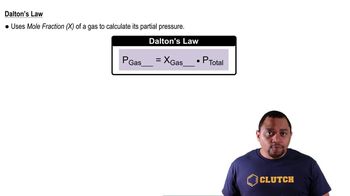
A gas mixture contains 1.25 g N2 and 0.85 g O2 in a 1.55 L container at 18 °C. Calculate the mole fraction and partial pressure of each component in the gas mixture.
2513
views
1
rank

 Guida verificata passo dopo passo
 00:27
00:27
 01:15
01:15 02:11
02:11A gas mixture contains 1.25 g N2 and 0.85 g O2 in a 1.55 L container at 18 °C. Calculate the mole fraction and partial pressure of each component in the gas mixture.
A 275-mL flask contains pure helium at a pressure of 752 torr. A second flask with a volume of 475 mL contains pure argon at a pressure of 722 torr. If we connect the two flasks through a stopcock and we open the stopcock, what is the partial pressure of argon?
A 1.20-g sample of dry ice is added to a 755 mL flask containing nitrogen gas at a temperature of 25.0 °C and a pressure of 725 mmHg. The dry ice sublimes (converts from solid to gas), and the mixture returns to 25.0 °C. What is the total pressure in the flask?
A sample of gas has a mass of 38.8 mg. Its volume is 224 mL at a temperature of 55 °C and a pressure of 886 torr. Find the molar mass of the gas.
A sample of gas has a mass of 0.555 g. Its volume is 117 mL at a temperature of 85 °C and a pressure of 753 mmHg. Find the molar mass of the gas.
A gas mixture contains each of the following gases at the indicated partial pressures: N2, 215 torr; O2, 102 torr; and He, 117 torr. What is the total pressure of the mixture? What mass of each gas is present in a 1.35-L sample of this mixture at 25.0 °C?