Ch.5 - Gases
Tro - Chemistry: A Molecular Approach 4th Edition
Tro4th EditionChemistry: A Molecular ApproachISBN: 9780134112831Non è quello che usi tu?Cambia libro di testo
Capitolo 5, Problema 32

A sample of gas has an initial volume of 13.9 L at a pressure of 1.22 atm. If the sample is compressed to a volume of 10.3 L, what is its pressure?

Guida verificata passo dopo passo
1
Identify the initial conditions: initial volume \( V_1 = 13.9 \text{ L} \) and initial pressure \( P_1 = 1.22 \text{ atm} \).
Identify the final condition: final volume \( V_2 = 10.3 \text{ L} \).
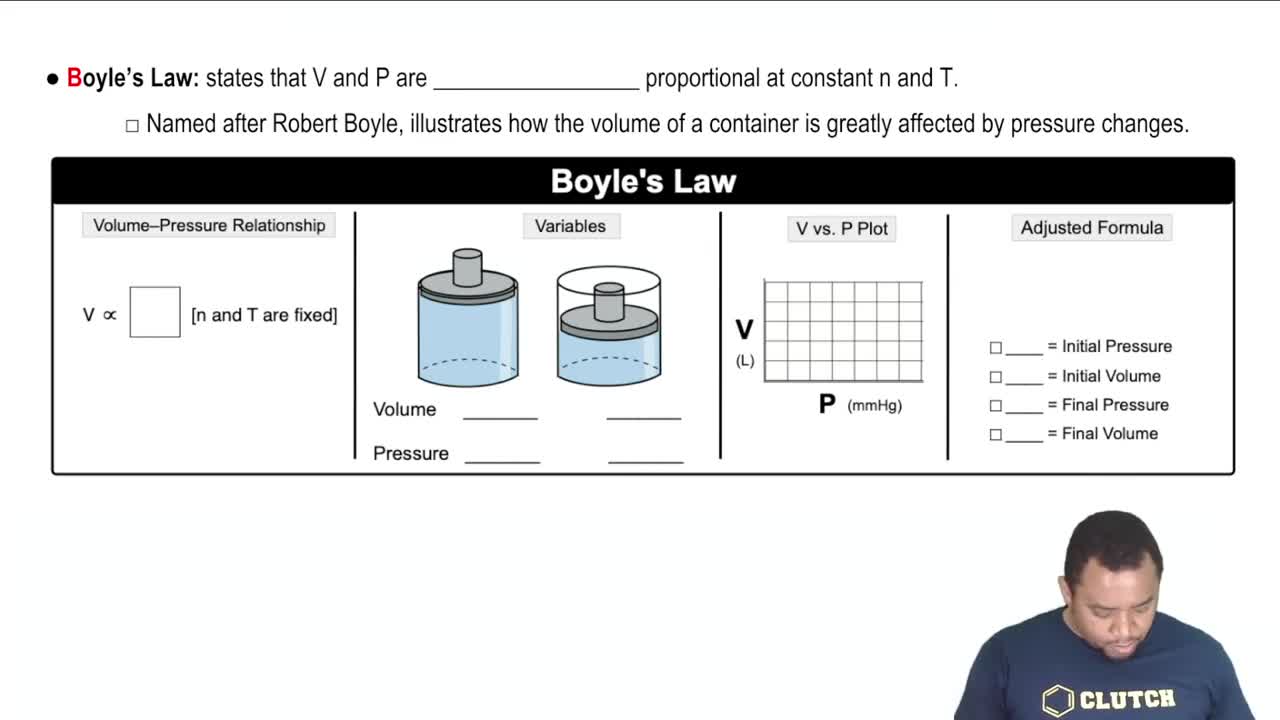
Use Boyle's Law, which states that for a given amount of gas at constant temperature, the pressure of the gas is inversely proportional to its volume: \( P_1 \times V_1 = P_2 \times V_2 \).
Rearrange the equation to solve for the final pressure \( P_2 \): \( P_2 = \frac{P_1 \times V_1}{V_2} \).
Substitute the known values into the equation to find \( P_2 \): \( P_2 = \frac{1.22 \text{ atm} \times 13.9 \text{ L}}{10.3 \text{ L}} \).

Risposta video verificata per un problema simile:

Questa soluzione video è stata consigliata dai nostri tutor come utile per risolvere questo problema.
Durata del video:
1m

Concetti chiave

Ecco i concetti essenziali che devi comprendere per rispondere correttamente alla domanda.

Boyle's Law

Boyle's Law states that the pressure of a gas is inversely proportional to its volume when the temperature and the amount of gas are held constant. This means that if the volume decreases, the pressure increases, and vice versa. The relationship can be expressed mathematically as P1V1 = P2V2, where P1 and V1 are the initial pressure and volume, and P2 and V2 are the final pressure and volume.
Video consigliato:

Ideal Gas Law

The Ideal Gas Law combines several gas laws into one equation: PV = nRT, where P is pressure, V is volume, n is the number of moles of gas, R is the ideal gas constant, and T is temperature. While this question primarily uses Boyle's Law, understanding the Ideal Gas Law provides a broader context for gas behavior under varying conditions, especially when considering the effects of temperature and quantity.
Video consigliato:
Percorso guidato
01:15
Ideal Gas Law Formula

Units of Pressure

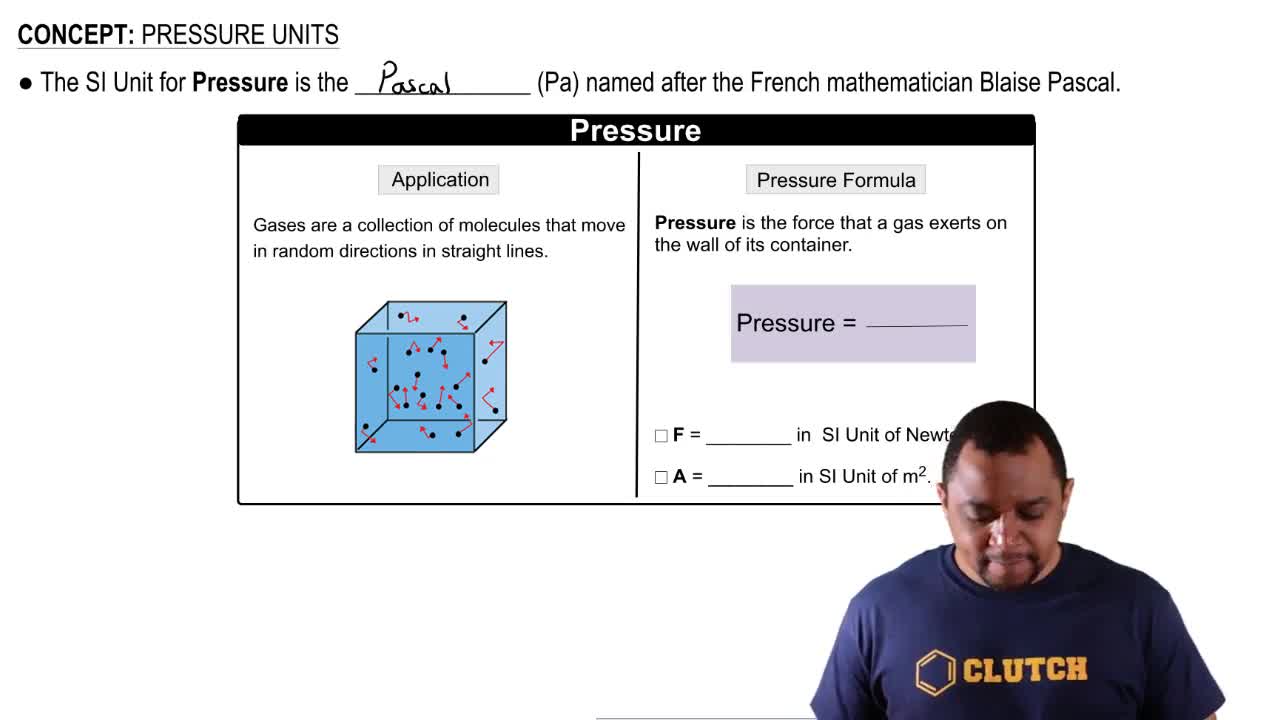
Pressure is commonly measured in units such as atmospheres (atm), pascals (Pa), or millimeters of mercury (mmHg). In this question, pressure is given in atmospheres, which is a standard unit in gas law calculations. It's important to ensure that all units are consistent when applying gas laws to avoid calculation errors.
Video consigliato: