Ch.5 - Gases
Tro - Chemistry: A Molecular Approach 4th Edition
Tro4th EditionChemistry: A Molecular ApproachISBN: 9780134112831Non è quello che usi tu?Cambia libro di testo
Capitolo 5, Problema 51

Aerosol cans carry clear warnings against incineration because of the high pressures that can develop upon heating. Suppose that a can contains a residual amount of gas at a pressure of 755 mmHg and a temperature of 25 °C. What would the pressure be if the can were heated to 1155 °C?

Guida verificata passo dopo passo
1
Identify the initial and final conditions of the gas: initial pressure \( P_1 = 755 \text{ mmHg} \), initial temperature \( T_1 = 25 \degree C \), and final temperature \( T_2 = 1155 \degree C \).
Convert the temperatures from Celsius to Kelvin using the formula \( T(K) = T(\degree C) + 273.15 \).
Apply Gay-Lussac's Law, which states that \( \frac{P_1}{T_1} = \frac{P_2}{T_2} \), where \( P_2 \) is the final pressure we want to find.
Rearrange the equation to solve for \( P_2 \): \( P_2 = P_1 \times \frac{T_2}{T_1} \).
Substitute the known values into the equation to calculate \( P_2 \).

Risposta video verificata per un problema simile:

Questa soluzione video è stata consigliata dai nostri tutor come utile per risolvere questo problema.

Concetti chiave

Ecco i concetti essenziali che devi comprendere per rispondere correttamente alla domanda.

Gas Laws

Gas laws describe the behavior of gases in relation to pressure, volume, and temperature. The most relevant here is the Ideal Gas Law, which states that for a given amount of gas, the pressure is directly proportional to the temperature when volume is constant. This relationship is crucial for predicting how the pressure in the aerosol can will change as the temperature increases.
Video consigliato:
Percorso guidato
01:43
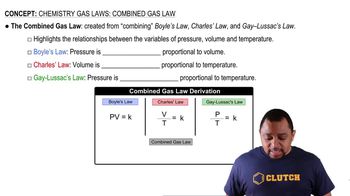
Combined Gas Law

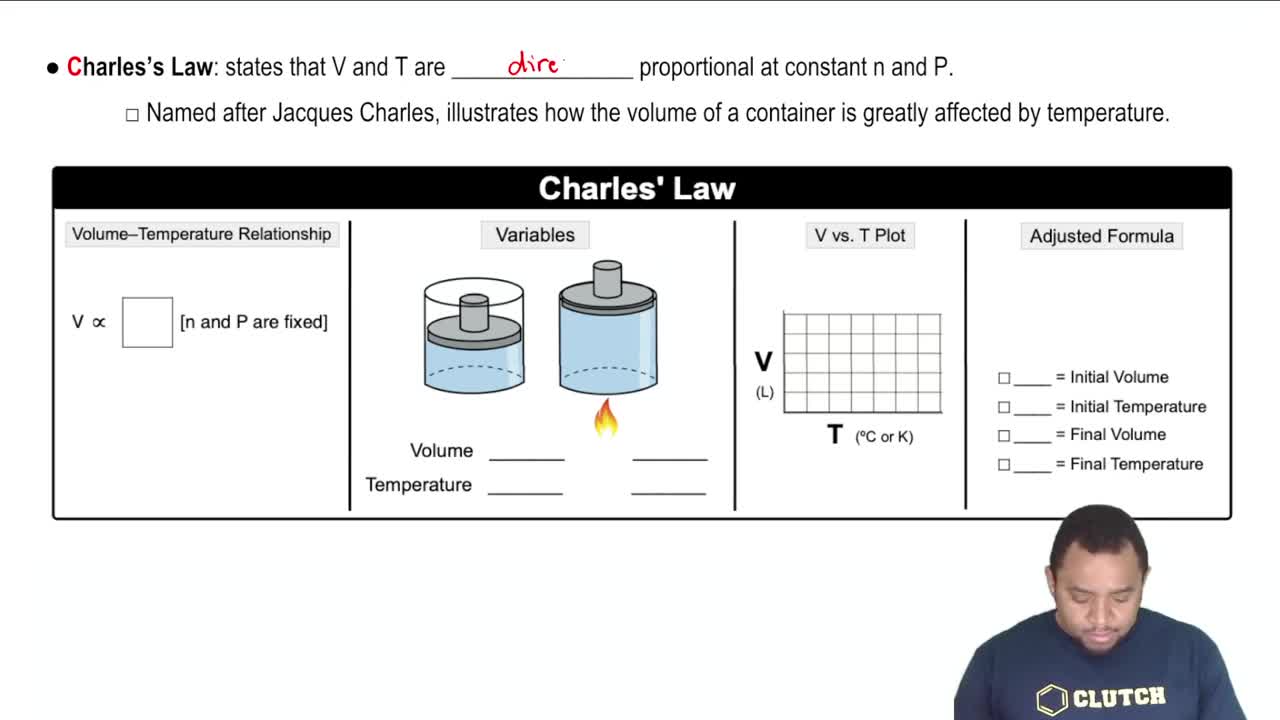
Charles's Law

Charles's Law specifically states that the volume of a gas is directly proportional to its temperature when pressure is held constant. Although the volume of the aerosol can does not change, understanding this law helps in grasping how temperature affects pressure. In this scenario, as the temperature rises, the pressure inside the can will also increase significantly.
Video consigliato:

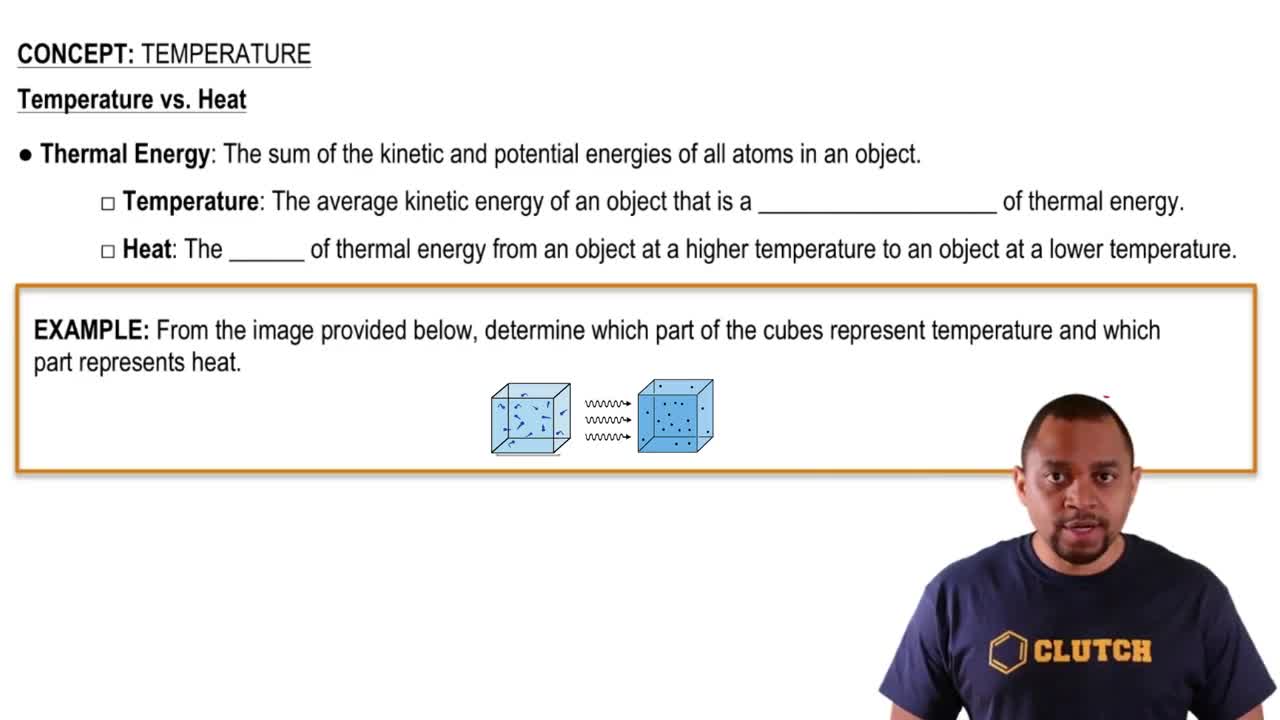
Absolute Temperature

Absolute temperature is measured in Kelvin and is essential for gas law calculations. To convert Celsius to Kelvin, you add 273.15. This conversion is necessary because gas laws require temperature to be in absolute terms to accurately predict changes in pressure and volume, ensuring that calculations reflect the true kinetic energy of gas particles.
Video consigliato:
Percorso guidato
03:48
Temperature vs Heat