


Ch.5 - Gases
Tro - Chemistry: A Molecular Approach 4th Edition
Tro4th EditionChemistry: A Molecular ApproachISBN: 9780134112831Non è quello che usi tu?Cambia libro di testo
Capitolo 5, Problema 102

Consider the reaction: 2 Ag2O(s) → 4 Ag(s) + O2(g) If this reaction produces 15.8 g of Ag(s), what total volume of gas can be collected over water at a temperature of 25 °C and a total pressure of 752 mmHg?

Guida verificata passo dopo passo
1
Identify the balanced chemical equation: \(2 \text{Ag}_2\text{O}(s) \rightarrow 4 \text{Ag}(s) + \text{O}_2(g)\).
Calculate the moles of Ag produced using its molar mass: \(\text{moles of Ag} = \frac{15.8 \text{ g}}{\text{molar mass of Ag}}\).
Use stoichiometry to find the moles of \(\text{O}_2\) produced: \(\text{moles of O}_2 = \frac{1}{4} \times \text{moles of Ag}\).
Use the ideal gas law to find the volume of \(\text{O}_2\) at the given conditions: \(PV = nRT\), where \(P\) is the pressure of \(\text{O}_2\) (corrected for water vapor), \(V\) is the volume, \(n\) is the moles of \(\text{O}_2\), \(R\) is the ideal gas constant, and \(T\) is the temperature in Kelvin.
Adjust the total pressure to account for water vapor pressure at 25 °C, then solve for the volume of \(\text{O}_2\).

Risposta video verificata per un problema simile:

Questa soluzione video è stata consigliata dai nostri tutor come utile per risolvere questo problema.
Durata del video:
7m

Concetti chiave

Ecco i concetti essenziali che devi comprendere per rispondere correttamente alla domanda.

Stoichiometry

Stoichiometry is the calculation of reactants and products in chemical reactions based on the balanced equation. It allows us to determine the amount of substances consumed and produced in a reaction. In this case, knowing the amount of silver produced helps us find the moles of oxygen gas generated, which is essential for further calculations.
Video consigliato:
Percorso guidato
01:16
Stoichiometry Concept

Ideal Gas Law

The Ideal Gas Law relates the pressure, volume, temperature, and number of moles of a gas through the equation PV = nRT. This law is crucial for calculating the volume of gas produced in the reaction. By rearranging the equation, we can solve for volume when we know the number of moles of gas and the conditions of temperature and pressure.
Video consigliato:
Percorso guidato
01:15
Ideal Gas Law Formula

Dalton's Law of Partial Pressures

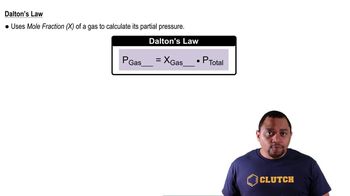
Dalton's Law states that the total pressure of a gas mixture is equal to the sum of the partial pressures of each individual gas. When collecting gas over water, the vapor pressure of water must be considered. This means that the pressure of the gas collected must be adjusted by subtracting the vapor pressure of water at the given temperature to find the pressure of the dry gas.
Video consigliato:
Percorso guidato
00:27
Dalton's Law and Partial Pressure