Ch.5 - Gases
Tro - Chemistry: A Molecular Approach 4th Edition
Tro4th EditionChemistry: A Molecular ApproachISBN: 9780134112831Non è quello che usi tu?Cambia libro di testo
Capitolo 5, Problema 125

In a given diffusion apparatus, 15.0 mL of HBr gas diffuses in 1.0 min. In the same apparatus and under the same conditions, 20.3 mL of an unknown gas diffuses in 1.0 min. The unknown gas is a hydrocarbon. Find its molecular formula.

Guida verificata passo dopo passo
1
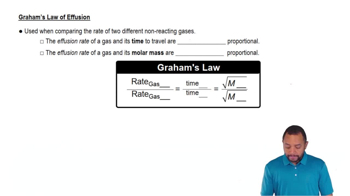
Use Graham's law of effusion, which states that the rate of effusion of a gas is inversely proportional to the square root of its molar mass: \( \frac{r_1}{r_2} = \sqrt{\frac{M_2}{M_1}} \).
Identify the known values: \( r_1 = 15.0 \text{ mL/min} \) for HBr and \( r_2 = 20.3 \text{ mL/min} \) for the unknown gas. The molar mass of HBr (\( M_1 \)) is approximately 80.91 g/mol.
Rearrange Graham's law to solve for the molar mass of the unknown gas (\( M_2 \)): \( M_2 = M_1 \left( \frac{r_1}{r_2} \right)^2 \).
Substitute the known values into the equation to calculate \( M_2 \).
Determine the molecular formula of the hydrocarbon by comparing the calculated molar mass to the molar masses of possible hydrocarbons (e.g., CH₄, C₂H₆, C₃H₈, etc.).

Risposta video verificata per un problema simile:

Questa soluzione video è stata consigliata dai nostri tutor come utile per risolvere questo problema.
Durata del video:
5m

Concetti chiave

Ecco i concetti essenziali che devi comprendere per rispondere correttamente alla domanda.

Graham's Law of Effusion

Graham's Law states that the rate of effusion or diffusion of a gas is inversely proportional to the square root of its molar mass. This means that lighter gases diffuse faster than heavier gases. In this problem, the relationship between the diffusion rates of HBr and the unknown hydrocarbon can be used to determine the molar mass of the unknown gas.
Video consigliato:
Percorso guidato
2:03
Graham's Law of Effusion

Molar Mass Calculation

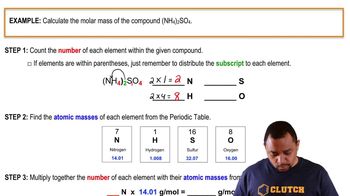
Molar mass is the mass of one mole of a substance, typically expressed in grams per mole (g/mol). To find the molecular formula of the unknown hydrocarbon, we need to calculate its molar mass based on the diffusion rates provided. By applying Graham's Law, we can derive the molar mass of the unknown gas from the known molar mass of HBr.
Video consigliato:
Percorso guidato
03:12
Molar Mass Calculation Example

Hydrocarbon Structure

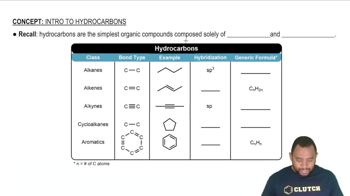
Hydrocarbons are organic compounds consisting entirely of hydrogen and carbon. They can be classified into alkanes, alkenes, and alkynes based on the types of bonds between carbon atoms. Understanding the general structure of hydrocarbons is essential for deducing the molecular formula once the molar mass is determined, as it helps identify possible combinations of carbon and hydrogen atoms.
Video consigliato:
Percorso guidato
04:29
Intro To Hydrocarbons