Ch.5 - Gases
Tro - Chemistry: A Molecular Approach 4th Edition
Tro4th EditionChemistry: A Molecular ApproachISBN: 9780134112831Non è quello che usi tu?Cambia libro di testo
Capitolo 5, Problema 25b

The pressure in Denver, Colorado (elevation 5280 ft), averages about 24.9 in Hg. Convert this pressure to each indicated unit. b. mmHg

Guida verificata passo dopo passo
1
Identify the given pressure in inches of mercury (in Hg), which is 24.9 in Hg.
Recall the conversion factor between inches of mercury and millimeters of mercury: 1 in Hg = 25.4 mmHg.
Set up the conversion by multiplying the given pressure in inches of mercury by the conversion factor: 24.9 in Hg * 25.4 mmHg/in Hg.
Perform the multiplication to convert the pressure from inches of mercury to millimeters of mercury.
The result will give you the pressure in mmHg.

Risposta video verificata per un problema simile:

Questa soluzione video è stata consigliata dai nostri tutor come utile per risolvere questo problema.
Durata del video:
34s

Concetti chiave

Ecco i concetti essenziali che devi comprendere per rispondere correttamente alla domanda.

Pressure Units

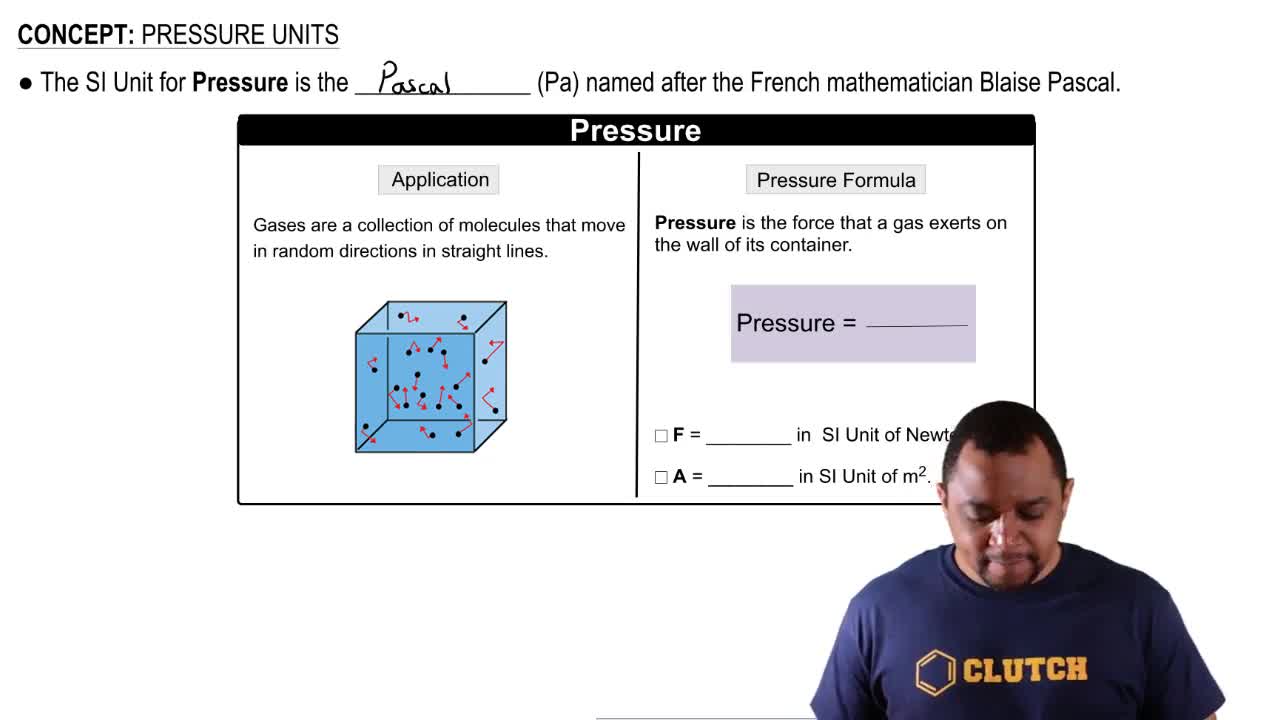
Pressure is a measure of the force exerted by a fluid per unit area. Common units for pressure include inches of mercury (in Hg), millimeters of mercury (mmHg), and pascals (Pa). Understanding how to convert between these units is essential for solving problems related to pressure in different contexts.
Video consigliato:

Unit Conversion

Unit conversion involves changing a quantity expressed in one unit to another unit without changing its value. For pressure, the conversion between in Hg and mmHg is straightforward, as 1 in Hg is equivalent to 25.4 mmHg. Mastery of conversion factors is crucial for accurately interpreting and comparing measurements.
Video consigliato:
Percorso guidato
01:56
Conversion Factors

Barometric Pressure

Barometric pressure refers to the pressure exerted by the weight of the atmosphere at a given location. It varies with altitude, with lower pressures found at higher elevations. In Denver, the average pressure of 24.9 in Hg reflects its elevation of 5280 ft, which is important for understanding how atmospheric conditions affect pressure readings.
Video consigliato: