The pressure on top of Mount Everest (29,029 ft) averages about 235 mmHg. Convert this pressure to each indicated unit. a. torr b. psi c. in Hg d. atm
Ch.5 - Gases
Tro4th EditionChemistry: A Molecular ApproachISBN: 9780134112831Non è quello che usi tu?Cambia libro di testo
Capitolo 5, Problema 28a,c
The world record for lowest pressure (at sea level) was 652.5 mmHg recorded inside Typhoon Tip on October 12, 1979, in the western Pacific Ocean. Convert this pressure to each indicated unit. a. torr c. in Hg
Guida verificata passo dopo passo1
insert step 1: Understand that 1 mmHg is equivalent to 1 torr, so the pressure in torr is the same as in mmHg.
insert step 2: For part c, recognize that 1 inch of mercury (in Hg) is equivalent to 25.4 mmHg.
insert step 3: To convert mmHg to in Hg, use the conversion factor: \( \text{in Hg} = \frac{\text{mmHg}}{25.4} \).
insert step 4: Substitute the given pressure in mmHg (652.5 mmHg) into the conversion formula to find the pressure in in Hg.
insert step 5: Perform the division to complete the conversion from mmHg to in Hg.

Risposta video verificata per un problema simile:
Questa soluzione video è stata consigliata dai nostri tutor come utile per risolvere questo problema.
Durata del video:
4mConcetti chiave
Ecco i concetti essenziali che devi comprendere per rispondere correttamente alla domanda.
Pressure Units
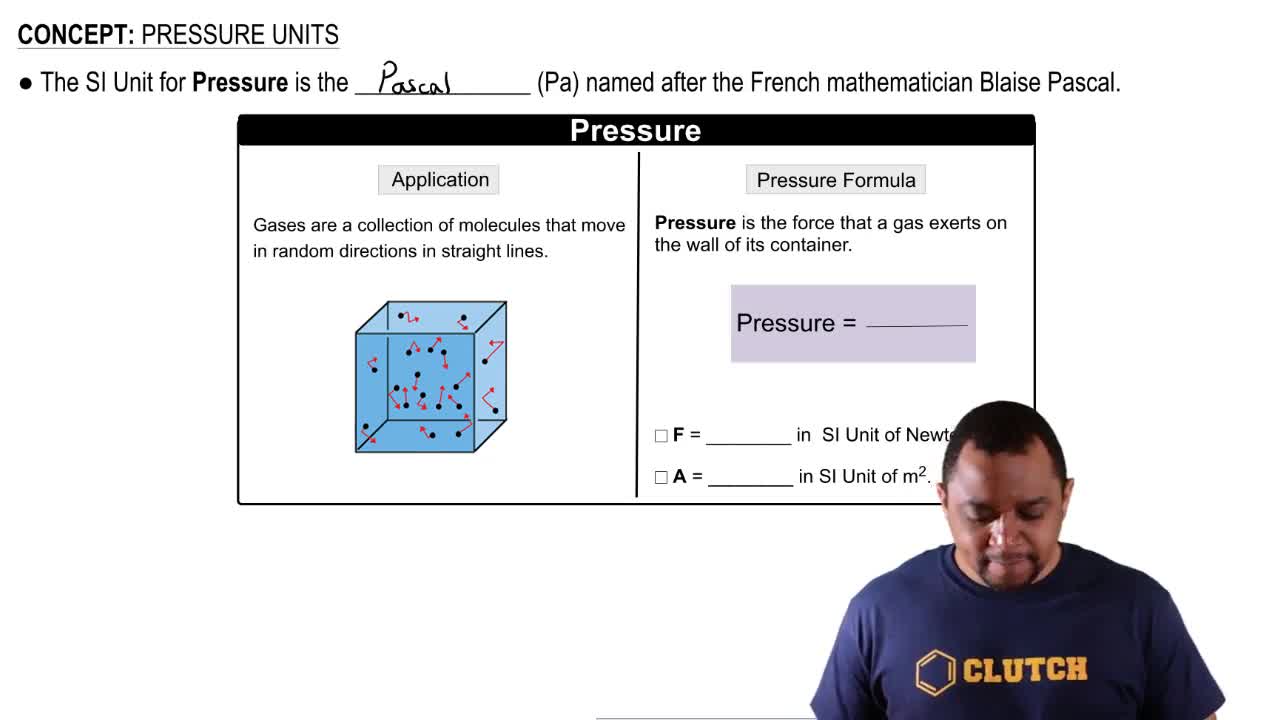
Pressure is a measure of force applied per unit area and can be expressed in various units, including mmHg (millimeters of mercury), torr, and inches of mercury (inHg). These units are commonly used in meteorology and medicine to quantify atmospheric pressure. Understanding the relationships between these units is essential for converting pressure values accurately.
Video consigliato:
Percorso guidato
Pressure Units
Conversion Factors
To convert between different units of pressure, specific conversion factors are used. For instance, 1 mmHg is equivalent to 1 torr, and 1 inHg is approximately equal to 25.4 mmHg. Knowing these conversion factors allows for straightforward calculations when changing from one unit to another, which is crucial for solving problems involving pressure measurements.
Video consigliato:
Percorso guidato
Conversion Factors
Atmospheric Pressure
Atmospheric pressure is the pressure exerted by the weight of the atmosphere above a given point. At sea level, standard atmospheric pressure is defined as 760 mmHg, 760 torr, or 29.92 inHg. Understanding this baseline is important for interpreting pressure readings and making conversions, as it provides context for the values being analyzed.
Video consigliato:
Percorso guidato
Total Pressure Example
Pratica correlata
Domanda del libro di testo
4565
views
1
rank
Domanda del libro di testo
Given a barometric pressure of 751.5 mmHg, calculate the pressure of each gas sample as indicated by the manometer.
(a)
3686
views
1
comments
Domanda del libro di testo
The North American record for highest recorded barometric pressure is 31.85 in Hg, set in 1989 in Northway, Alaska. Convert this pressure to each indicated unit. a. mmHg
2946
views
Domanda del libro di testo
The world record for lowest pressure (at sea level) was 652.5 mmHg recorded inside Typhoon Tip on October 12, 1979, in the western Pacific Ocean. Convert this pressure to each indicated unit. b. atm
3090
views
Domanda del libro di testo
The world record for lowest pressure (at sea level) was 652.5 mmHg recorded inside Typhoon Tip on October 12, 1979, in the western Pacific Ocean. Convert this pressure to each indicated unit. d. psi
584
views