
The propane fuel (C3H8) used in gas barbeques burns according to the thermochemical equation: C3H8(g) + 5 O2(g) → 3 CO2(g) + 4 H2O(g) ΔH°rxn = –2044 kJ If a pork roast must absorb 1.6×10³ kJ to fully cook, and if only 10% of the heat produced by the barbeque is actually absorbed by the roast, what mass of CO2 is emitted into the atmosphere during the grilling of the pork roast?
Ch.6 - Thermochemistry
Tro4th EditionChemistry: A Molecular ApproachISBN: 9780134112831Non è quello che usi tu?Cambia libro di testo
Capitolo 6, Problema 61
Nitromethane (CH3NO2) burns in air to produce significant amounts of heat. 2 CH3NO2(l) + 3/2 O2(g) → 2 CO2(g) + 3 H2O(l) + N2(g) ΔH°rxn = –1418 kJ How much heat is produced by the complete reaction of 5.56 kg of nitromethane?
Guida verificata passo dopo passo1
Convert the mass of nitromethane (5.56 kg) to grams by multiplying by 1000.
Calculate the number of moles of nitromethane using its molar mass (CH3NO2). The molar mass is the sum of the atomic masses of all atoms in the molecule.
Use the stoichiometry of the balanced chemical equation to determine the relationship between moles of nitromethane and the enthalpy change (ΔH°rxn).
Calculate the total heat produced by multiplying the number of moles of nitromethane by the enthalpy change per mole of reaction (ΔH°rxn).
Ensure the units are consistent and convert the final answer to kilojoules if necessary.

Risposta video verificata per un problema simile:
Questa soluzione video è stata consigliata dai nostri tutor come utile per risolvere questo problema.
Durata del video:
1mConcetti chiave
Ecco i concetti essenziali che devi comprendere per rispondere correttamente alla domanda.
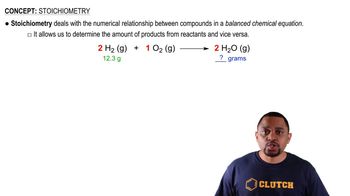
Stoichiometry
Stoichiometry is the calculation of reactants and products in chemical reactions based on the balanced chemical equation. It allows us to determine the proportions of substances involved in a reaction, which is essential for calculating how much heat is produced when a specific amount of a reactant, like nitromethane, is consumed.
Video consigliato:
Percorso guidato
Stoichiometry Concept
Enthalpy Change (ΔH)
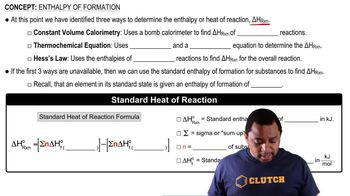
Enthalpy change (ΔH) represents the heat absorbed or released during a chemical reaction at constant pressure. In this case, the negative value of ΔH indicates that the reaction is exothermic, meaning it releases heat. Understanding ΔH is crucial for calculating the total heat produced from the combustion of nitromethane.
Video consigliato:
Percorso guidato
Enthalpy of Formation
Molar Mass
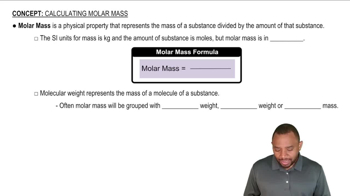
Molar mass is the mass of one mole of a substance, typically expressed in grams per mole (g/mol). To find out how much heat is produced from a given mass of nitromethane, we first need to convert the mass of nitromethane (5.56 kg) into moles using its molar mass, which is essential for applying stoichiometry in the heat calculation.
Video consigliato:
Percorso guidato
Molar Mass Concept
Pratica correlata
Domanda del libro di testo
6036
views
Domanda del libro di testo
Charcoal is primarily carbon. Determine the mass of CO2 produced by burning enough carbon (in the form of charcoal) to produce 5.00×10² kJ of heat. C(s) + O2(g) → CO2(g) ΔH°rxn = –393.5 kJ
3374
views
Domanda del libro di testo
Titanium reacts with iodine to form titanium(III) iodide, emitting heat. 2 Ti(s) + 3 I2(g) → 2 TiI3(s) ΔH°rxn = –839 kJ Determine the mass of titanium that react if 1.55×10³ kJ of heat is emitted by the reaction.
1684
views
Domanda del libro di testo
Determine whether each process is exothermic or endothermic and indicate the sign of ΔH. a. dry ice evaporating b. a sparkler burning c. the reaction that occurs in a chemical cold pack used to ice athletic injuries
579
views
Domanda del libro di testo
What mass of natural gas (CH4) must burn to emit 267 kJ of heat? CH4(g) + 2 O2(g) → CO2(g) + 2 H2O(g) ΔH°rxn = –802.3 kJ
4216
views
2
comments
