Ch.6 - Thermochemistry
Tro - Chemistry: A Molecular Approach 4th Edition
Tro4th EditionChemistry: A Molecular ApproachISBN: 9780134112831Non è quello che usi tu?Cambia libro di testo
Capitolo 6, Problema 7

A 2.74-g sample of a substance suspected of being pure gold is warmed to 72.1 °C and submerged into 15.2 g of water initially at 24.7 °C. The final temperature of the mixture is 26.3 °C. What is the heat capacity of the unknown substance? Could the substance be pure gold?

Guida verificata passo dopo passo
1
Identify the known values: mass of the substance (m_1 = 2.74 \(\text{ g}\)), initial temperature of the substance (T_{i1} = 72.1 \(\text{ °C}\)), mass of water (m_2 = 15.2 \(\text{ g}\)), initial temperature of water (T_{i2} = 24.7 \(\text{ °C}\)), and final temperature of the mixture (T_f = 26.3 \(\text{ °C}\)).
Use the formula for heat transfer: q = mc\(\Delta\) T, where q is the heat absorbed or released, m is the mass, c is the specific heat capacity, and \(\Delta\) T is the change in temperature.
Calculate the heat gained by the water: q_{water} = m_2 \(\cdot\) c_{water} \(\cdot\) (T_f - T_{i2}), where c_{water} = 4.18 \(\text{ J/g°C}\).
Assume no heat is lost to the surroundings, so the heat lost by the substance is equal to the heat gained by the water: q_{substance} = -q_{water}.
Calculate the specific heat capacity of the substance: c_{substance} = \(\frac{-q_{water}\)}{m_1 \(\cdot\) (T_f - T_{i1})}. Compare this value to the known specific heat capacity of gold (0.129 \(\text{ J/g°C}\)) to determine if the substance could be pure gold.

Concetti chiave

Ecco i concetti essenziali che devi comprendere per rispondere correttamente alla domanda.

Heat Transfer and Specific Heat Capacity

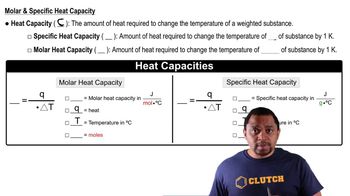
Heat transfer occurs when thermal energy moves from a warmer object to a cooler one until thermal equilibrium is reached. The specific heat capacity is the amount of heat required to raise the temperature of one gram of a substance by one degree Celsius. This concept is crucial for calculating the heat absorbed or released by substances during temperature changes.
Video consigliato:

Calorimetry

Calorimetry is the science of measuring the heat of chemical reactions or physical changes. In this scenario, the principle of calorimetry is applied to determine the heat lost by the gold sample and the heat gained by the water. By using the formula Q = mcΔT, where Q is heat, m is mass, c is specific heat capacity, and ΔT is the change in temperature, we can analyze the heat exchange.
Video consigliato:
Percorso guidato
00:50
Constant-Volume Calorimetry

Determining Material Properties

To determine if the unknown substance could be pure gold, we compare its calculated heat capacity to the known specific heat capacity of gold, which is approximately 0.129 J/g°C. If the calculated value aligns closely with this known value, it supports the hypothesis that the substance is indeed pure gold. This concept emphasizes the importance of comparing experimental data with established values to identify materials.
Video consigliato:
Percorso guidato
08:12
Laboratory Materials 2