
Ch.6 - Thermochemistry
Tro - Chemistry: A Molecular Approach 4th Edition
Tro4th EditionChemistry: A Molecular ApproachISBN: 9780134112831Non è quello che usi tu?Cambia libro di testo
Capitolo 6, Problema 67

A 31.1-g wafer of pure gold, initially at 69.3 °C, is submerged into 64.2 g of water at 27.8 °C in an insulated container. What is the final temperature of both substances at thermal equilibrium?

Guida verificata passo dopo passo
1
Identify the specific heat capacities for gold and water. The specific heat capacity of gold is approximately 0.129 J/g°C, and for water, it is approximately 4.18 J/g°C.
Set up the heat transfer equation assuming no heat is lost to the surroundings. The heat lost by gold will equal the heat gained by water. Use the formula: \(m_{gold} \cdot c_{gold} \cdot (T_{final} - T_{initial, gold}) = m_{water} \cdot c_{water} \cdot (T_{final} - T_{initial, water})\).
Substitute the masses and specific heat capacities of gold and water into the equation. Replace \(m_{gold}\) with 31.1 g, \(c_{gold}\) with 0.129 J/g°C, \(T_{initial, gold}\) with 69.3 °C, \(m_{water}\) with 64.2 g, and \(c_{water}\) with 4.18 J/g°C, and \(T_{initial, water}\) with 27.8 °C.
Solve the equation for \(T_{final}\), the final temperature. This will involve algebraic manipulation to isolate \(T_{final}\) on one side of the equation.
Check the physical plausibility of your answer. The final temperature should be between the initial temperatures of the gold and the water, and closer to the initial temperature of the substance with the higher heat capacity (water in this case).

Risposta video verificata per un problema simile:

Questa soluzione video è stata consigliata dai nostri tutor come utile per risolvere questo problema.
Durata del video:
6m

Concetti chiave

Ecco i concetti essenziali che devi comprendere per rispondere correttamente alla domanda.

Thermal Equilibrium

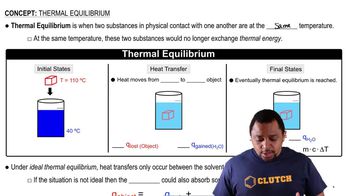
Thermal equilibrium occurs when two substances at different temperatures are brought into contact, resulting in a transfer of heat until they reach the same temperature. In this scenario, the gold wafer and water will exchange heat until they stabilize at a common final temperature, which can be calculated using the principle of conservation of energy.
Video consigliato:
Percorso guidato
02:35
Thermal Equilibrium

Specific Heat Capacity

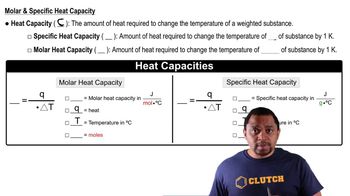
Specific heat capacity is the amount of heat required to raise the temperature of one gram of a substance by one degree Celsius. Each substance has a unique specific heat capacity, which influences how much heat it can absorb or release. For this problem, the specific heat capacities of gold and water will be essential in determining how much heat each substance exchanges during the thermal equilibrium process.
Video consigliato:

Heat Transfer Equation

The heat transfer equation, often expressed as Q = mcΔT, relates the heat gained or lost (Q) to the mass (m), specific heat capacity (c), and change in temperature (ΔT) of a substance. In this case, the heat lost by the gold will equal the heat gained by the water, allowing us to set up an equation to solve for the final equilibrium temperature.
Video consigliato:
Pratica correlata
Domanda del libro di testo

Exactly 1.5 g of a fuel burns under conditions of constant pressure and then again under conditions of constant volume. In measurement A the reaction produces 25.9 kJ of heat, and in measurement B the reaction produces 23.3 kJ of heat. Which measurement (A or B) corresponds to conditions of constant pressure? Explain.

1447
views
Domanda del libro di testo

Two substances, A and B, initially at different temperatures, come into contact and reach thermal equilibrium. The mass of substance A is 6.15 g and its initial temperature is 20.5 °C. The mass of substance B is 25.2 g and its initial temperature is 52.7 °C. The final temperature of both substances at thermal equilibrium is 46.7 °C. If the specific heat capacity of substance B is 1.17 J/g•°C, what is the specific heat capacity of substance A?

3164
views
1
rank
Domanda del libro di testo

Charcoal is primarily carbon. Determine the mass of CO2 produced by burning enough carbon (in the form of charcoal) to produce 5.00×10² kJ of heat. C(s) + O2(g) → CO2(g) ΔH°rxn = –393.5 kJ

3374
views
Domanda del libro di testo

A 2.85-g lead weight, initially at 10.3 °C, is submerged in 7.55 g of water at 52.3 °C in an insulated container. What is the final temperature of both substances at thermal equilibrium?

2970
views
4
rank
1
comments
Domanda del libro di testo

A 32.5-g iron rod, initially at 22.7 °C, is submerged into an unknown mass of water at 63.2 °C, in an insulated container. The final temperature of the mixture upon reaching thermal equilibrium is 59.5 °C. What is the mass of the water?

4045
views
Domanda del libro di testo

A silver block, initially at 58.5 °C, is submerged into 100.0 g of water at 24.8 °C, in an insulated container. The final temperature of the mixture upon reaching thermal equilibrium is 26.2 °C. What is the mass of the silver block?

2677
views
1
comments