Ch.6 - Thermochemistry
Tro - Chemistry: A Molecular Approach 4th Edition
Tro4th EditionChemistry: A Molecular ApproachISBN: 9780134112831Non è quello che usi tu?Cambia libro di testo
Capitolo 6, Problema 115

A gaseous fuel mixture contains 25.3% methane (CH4), 38.2% ethane (C2H6), and the rest propane (C3H8) by volume. When the fuel mixture contained in a 1.55 L tank, stored at 755 mmHg and 298 K, undergoes complete combustion, how much heat is emitted? (Assume that the water produced by the combustion is in the gaseous state.)

Guida verificata passo dopo passo
1
Determine the volume of each gas in the mixture by multiplying the total volume of the mixture by the percentage of each component. For example, calculate the volume of methane by multiplying 1.55 L by 25.3%.
Use the ideal gas law, PV = nRT, to calculate the number of moles of each gas. Here, P is the pressure in atmospheres (convert 755 mmHg to atm), V is the volume of each gas, R is the gas constant (0.0821 L atm/mol K), and T is the temperature in Kelvin.
Write the balanced chemical equations for the combustion of methane, ethane, and propane. For methane: CH4 + 2O2 ightarrow CO2 + 2H2O. For ethane: 2C2H6 + 7O2 ightarrow 4CO2 + 6H2O. For propane: C3H8 + 5O2 ightarrow 3CO2 + 4H2O.
Calculate the amount of heat released from the combustion of each gas using the stoichiometry of the reactions and the standard enthalpy changes of combustion for methane, ethane, and propane. Multiply the moles of each gas by the respective \\(\Delta H_{comb}\\) values.
Sum the heat quantities from each gas to find the total heat emitted from the combustion of the fuel mixture.

Risposta video verificata per un problema simile:

Questa soluzione video è stata consigliata dai nostri tutor come utile per risolvere questo problema.
Durata del video:
18m

Concetti chiave

Ecco i concetti essenziali che devi comprendere per rispondere correttamente alla domanda.

Combustion Reactions

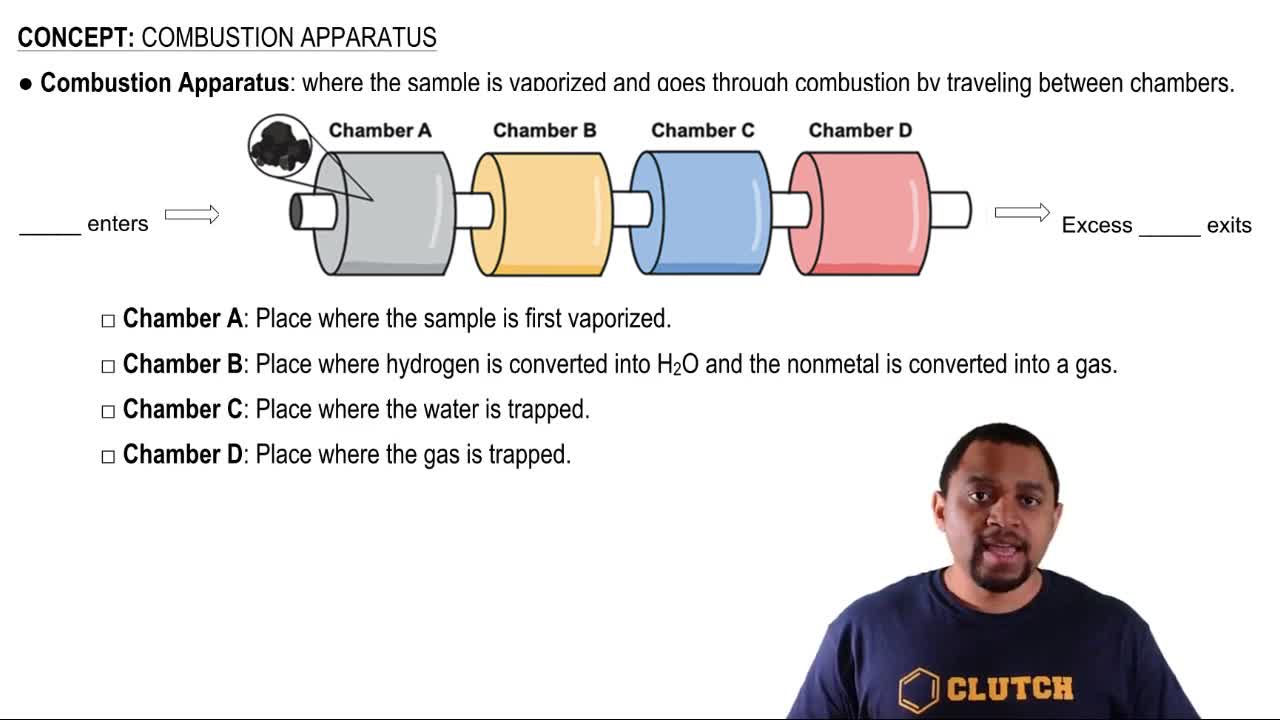
Combustion reactions are exothermic processes where a fuel reacts with an oxidant, typically oxygen, to produce heat, carbon dioxide, and water. In this case, the combustion of methane, ethane, and propane will release energy as they react with oxygen. Understanding the stoichiometry of these reactions is crucial for calculating the heat emitted.
Video consigliato:
Percorso guidato
02:24
Combustion Apparatus

Ideal Gas Law

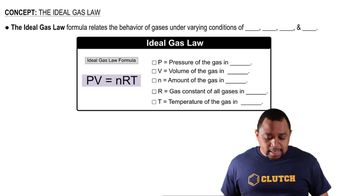
The Ideal Gas Law (PV=nRT) relates the pressure, volume, temperature, and number of moles of a gas. In this problem, it is used to determine the number of moles of the gaseous fuel mixture in the tank under the given conditions of pressure and temperature. This is essential for calculating the amount of each component in the mixture and subsequently the total heat released during combustion.
Video consigliato:
Percorso guidato
01:15
Ideal Gas Law Formula

Heat of Combustion

The heat of combustion is the amount of energy released when a substance undergoes complete combustion. Each hydrocarbon has a specific heat of combustion value, which can be used to calculate the total heat emitted from the combustion of the fuel mixture. Knowing the composition of the mixture allows for the weighted average of the heats of combustion to be calculated, leading to the total heat output.
Video consigliato:
Percorso guidato
02:24
Combustion Apparatus