

Ch.6 - Thermochemistry
Tro - Chemistry: A Molecular Approach 4th Edition
Tro4th EditionChemistry: A Molecular ApproachISBN: 9780134112831Non è quello che usi tu?Cambia libro di testo
Capitolo 6, Problema 93a

Determine the mass of CO2 produced by burning enough of each fuel to produce 1.00×10² kJ of heat. a. CH4(g) + 2 O2(g) → CO2(g) + 2 H2O(g) ΔH°rxn = –802.3 kJ

Guida verificata passo dopo passo
1
Identify the given reaction: CH4(g) + 2 O2(g) -> CO2(g) + 2 H2O(g) with ΔH°rxn = -802.3 kJ.
Understand that the reaction releases 802.3 kJ of heat per mole of CH4 burned.
Calculate the moles of CH4 needed to produce 1.00 * 10^2 kJ of heat using the ratio: (1 mole CH4 / 802.3 kJ) * 100 kJ.
Use the stoichiometry of the reaction to determine the moles of CO2 produced, which is a 1:1 ratio with CH4.
Convert the moles of CO2 to mass using the molar mass of CO2 (44.01 g/mol).

Risposta video verificata per un problema simile:

Questa soluzione video è stata consigliata dai nostri tutor come utile per risolvere questo problema.

Concetti chiave

Ecco i concetti essenziali che devi comprendere per rispondere correttamente alla domanda.

Stoichiometry

Stoichiometry is the calculation of reactants and products in chemical reactions based on the balanced chemical equation. It allows us to determine the amount of product formed or reactant consumed when a specific quantity of another substance is involved. In this case, it will help us calculate the mass of CO2 produced from the combustion of CH4 by using the given enthalpy change and the molar ratios from the reaction.
Video consigliato:
Percorso guidato
01:16
Stoichiometry Concept

Enthalpy Change (ΔH)

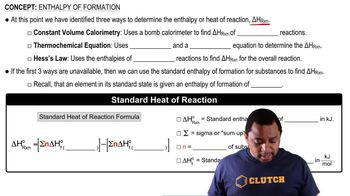
Enthalpy change (ΔH) is a measure of the heat energy absorbed or released during a chemical reaction at constant pressure. A negative ΔH indicates that the reaction is exothermic, meaning it releases heat. In this question, the ΔH of -802.3 kJ for the combustion of methane (CH4) indicates that burning one mole of CH4 releases this amount of energy, which is crucial for determining how much CO2 is produced for a specific heat output.
Video consigliato:
Percorso guidato
02:34
Enthalpy of Formation

Molar Mass

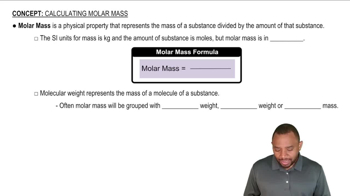
Molar mass is the mass of one mole of a substance, typically expressed in grams per mole (g/mol). It is essential for converting between the mass of a substance and the number of moles. In this problem, knowing the molar mass of CO2 will allow us to convert the moles of CO2 produced from the stoichiometric calculations into grams, providing the final answer for the mass of CO2 generated from the combustion of methane.
Video consigliato:
Percorso guidato
02:11
Molar Mass Concept
Pratica correlata
Domanda del libro di testo

Top fuel dragsters and funny cars burn nitromethane as fuel according to the balanced combustion equation: 2 CH3NO2(l) + 3/2O2(g) → 2 CO2(g) + 3 H2O(l) + N2(g) ΔH°rxn = –1418 kJ The enthalpy of combustion for nitromethane is –709.2 kJ/mol. Calculate the standard enthalpy of formation (ΔH°f ) for nitromethane.

3123
views
3
comments
Domanda del libro di testo

Ethanol (C2H5OH) can be made from the fermentation of crops and has been used as a fuel additive to gasoline. Write a balanced equation for the combustion of ethanol and calculate ΔH°rxn.

1712
views
Domanda del libro di testo

The explosive nitroglycerin (C3H5N3O9) decomposes rapidly upon ignition or sudden impact according to the balanced equation: 4 C3H5N3O9(l) → 12 CO2(g) + 10 H2O(g) + 6 N2(g) + O2(g) ΔH°rxn = –5678 kJ Calculate the standard enthalpy of formation (ΔH°f ) for nitroglycerin.

7072
views
Domanda del libro di testo

In a sunny location, sunlight has a power density of about 1 kW/m2. Photovoltaic solar cells can convert this power into electricity with 15% efficiency. If a typical home uses 385 kWh of electricity per month, how many square meters of solar cells are required to meet its energy requirements? Assume that electricity can be generated from the sunlight for 8 hours per day.

685
views
Domanda del libro di testo

Methanol (CH3OH) has been suggested as a fuel to replace gasoline. Find ΔH°rxn, and determine the mass of carbon dioxide emitted per kJ of heat produced. Use the information from the previous exercise to calculate the same quantity for octane, C8H18. How does methanol compare to octane with respect to global warming?

1193
views