Ch.6 - Thermochemistry
Tro - Chemistry: A Molecular Approach 4th Edition
Tro4th EditionChemistry: A Molecular ApproachISBN: 9780134112831Non è quello che usi tu?Cambia libro di testo
Capitolo 6, Problema 55

When 1 mol of a fuel burns at constant pressure, it produces 3452 kJ of heat and does 11 kJ of work. What are ΔE and ΔH for the combustion of the fuel?

Guida verificata passo dopo passo
1
Identify the given values: heat produced (q) = -3452 kJ and work done (w) = -11 kJ. Note that both values are negative because the system is losing energy.
Recall the first law of thermodynamics, which states that the change in internal energy (ΔE) is given by ΔE = q + w.
Substitute the given values into the equation: ΔE = (-3452 kJ) + (-11 kJ).
Recognize that at constant pressure, the change in enthalpy (ΔH) is equal to the heat exchanged, so ΔH = q.
Substitute the given value for heat into the equation for ΔH: ΔH = -3452 kJ.

Risposta video verificata per un problema simile:

Questa soluzione video è stata consigliata dai nostri tutor come utile per risolvere questo problema.

Concetti chiave

Ecco i concetti essenziali che devi comprendere per rispondere correttamente alla domanda.

First Law of Thermodynamics

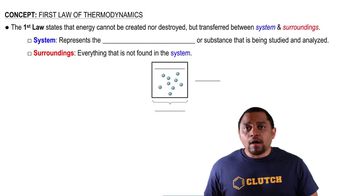
The First Law of Thermodynamics states that energy cannot be created or destroyed, only transformed from one form to another. In the context of chemical reactions, this principle implies that the change in internal energy (ΔE) of a system is equal to the heat added to the system minus the work done by the system on its surroundings.
Video consigliato:
Percorso guidato
01:18
First Law of Thermodynamics

Enthalpy (ΔH)

Enthalpy (ΔH) is a thermodynamic quantity that represents the total heat content of a system at constant pressure. It accounts for the internal energy of the system plus the product of its pressure and volume. For reactions occurring at constant pressure, the change in enthalpy is equal to the heat absorbed or released during the reaction.
Video consigliato:
Percorso guidato
02:34
Enthalpy of Formation

Work in Thermodynamics

In thermodynamics, work refers to the energy transferred when a force is applied over a distance. For chemical reactions, work can be done by the system on the surroundings, such as when gases expand against external pressure. The work done affects the internal energy change and must be considered when calculating the overall energy changes in a reaction.
Video consigliato:
Percorso guidato
01:18
First Law of Thermodynamics
Pratica correlata
Domanda del libro di testo

The change in internal energy for the combustion of 1.0 mol of octane at a pressure of 1.0 atm is 5084.3 kJ. If the change in enthalpy is 5074.1 kJ, how much work is done during the combustion?

2279
views

Domanda del libro di testo

Determine whether each process is exothermic or endothermic and indicate the sign of ΔH. a. natural gas burning on a stove b. isopropyl alcohol evaporating from skin c. water condensing from steam Indicate the sign of ΔH for the following processes.

549
views
Domanda del libro di testo

The average human lung expands by about 0.50 L during each breath. If this expansion occurs against an external pressure of 1.0 atm, how much work (in J) is done during the expansion?

2037
views
Domanda del libro di testo

The air within a piston equipped with a cylinder absorbs 565 J of heat and expands from an initial volume of 0.10 L to a final volume of 0.85 L against an external pressure of 1.0 atm. What is the change in internal energy of the air within the piston?

3726
views
2
rank
Domanda del libro di testo

Determine whether each process is exothermic or endothermic and indicate the sign of ΔH. a. natural gas burning on a stove b. isopropyl alcohol evaporating from skin c. water condensing from steam Determine whether each of the following is exothermic or endothermic.

1231
views
Domanda del libro di testo

A gas is compressed from an initial volume of 5.55 L to a final volume of 1.22 L by an external pressure of 1.00 atm. During the compression the gas releases 124 J of heat. What is the change in internal energy of the gas?

2904
views