Ch.7 - Quantum-Mechanical Model of the Atom
Tro - Chemistry: A Molecular Approach 4th Edition
Tro4th EditionChemistry: A Molecular ApproachISBN: 9780134112831Non è quello che usi tu?Cambia libro di testo
Capitolo 7, Problema 84

An atomic emission spectrum of hydrogen shows three wavelengths: 121.5 nm, 102.6 nm, and 97.23 nm. Assign these wavelengths to transitions in the hydrogen atom.

Guida verificata passo dopo passo
1
Identify the series of transitions in the hydrogen atom: Lyman, Balmer, and Paschen series.
Recognize that the Lyman series involves transitions to the n=1 energy level, Balmer to n=2, and Paschen to n=3.
Use the Rydberg formula for hydrogen: \( \frac{1}{\lambda} = R_H \left( \frac{1}{n_1^2} - \frac{1}{n_2^2} \right) \), where \( R_H \) is the Rydberg constant, \( n_1 \) is the lower energy level, and \( n_2 \) is the higher energy level.
Calculate the possible transitions for each wavelength using the Rydberg formula, starting with the Lyman series (n=1) since the given wavelengths are in the ultraviolet range.
Assign each wavelength to a specific transition by matching the calculated wavelengths to the given ones, confirming they belong to the Lyman series.

Risposta video verificata per un problema simile:

Questa soluzione video è stata consigliata dai nostri tutor come utile per risolvere questo problema.
Durata del video:
6m

Concetti chiave

Ecco i concetti essenziali che devi comprendere per rispondere correttamente alla domanda.

Atomic Emission Spectrum

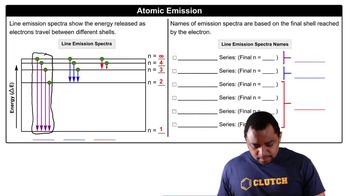
An atomic emission spectrum is a spectrum of the electromagnetic radiation emitted by a substance when its atoms transition from a higher energy state to a lower energy state. Each element has a unique emission spectrum, which can be used to identify the element and its electronic transitions. In hydrogen, these transitions correspond to specific wavelengths that can be observed in the ultraviolet region of the spectrum.
Video consigliato:
Percorso guidato
02:39
Atomic Emission Spectra

Energy Levels in Hydrogen Atom

The hydrogen atom has quantized energy levels, which are defined by the principal quantum number (n). Electrons can occupy these discrete energy levels, and when they absorb energy, they can jump to a higher level. When they return to a lower energy level, they emit energy in the form of light at specific wavelengths, which correspond to the differences in energy between the levels.
Video consigliato:
Percorso guidato
01:22
Hydrogenation Reactions

Balmer and Lyman Series

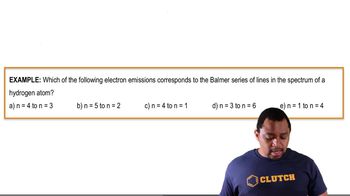
The Balmer and Lyman series are sets of spectral lines corresponding to electron transitions in the hydrogen atom. The Lyman series involves transitions to the n=1 level and emits ultraviolet light, while the Balmer series involves transitions to the n=2 level and emits visible light. The wavelengths provided in the question correspond to transitions in the Lyman series, specifically from n=2 to n=1 and n=3 to n=1.
Video consigliato:
Percorso guidato
01:00
Balmer Series Example